Nous utilisons des cookies essentiels au fonctionnement du site. Nous aimerions aussi déposer des cookies de mesure d’audience et des cookies publicitaires, uniquement avec votre accord. Vous pouvez choisir séparément pour chacun. Lire notre politique relative aux cookies

Loading
Recettes
Parcourez les archives par pays, par plat et par temps de cuisson.
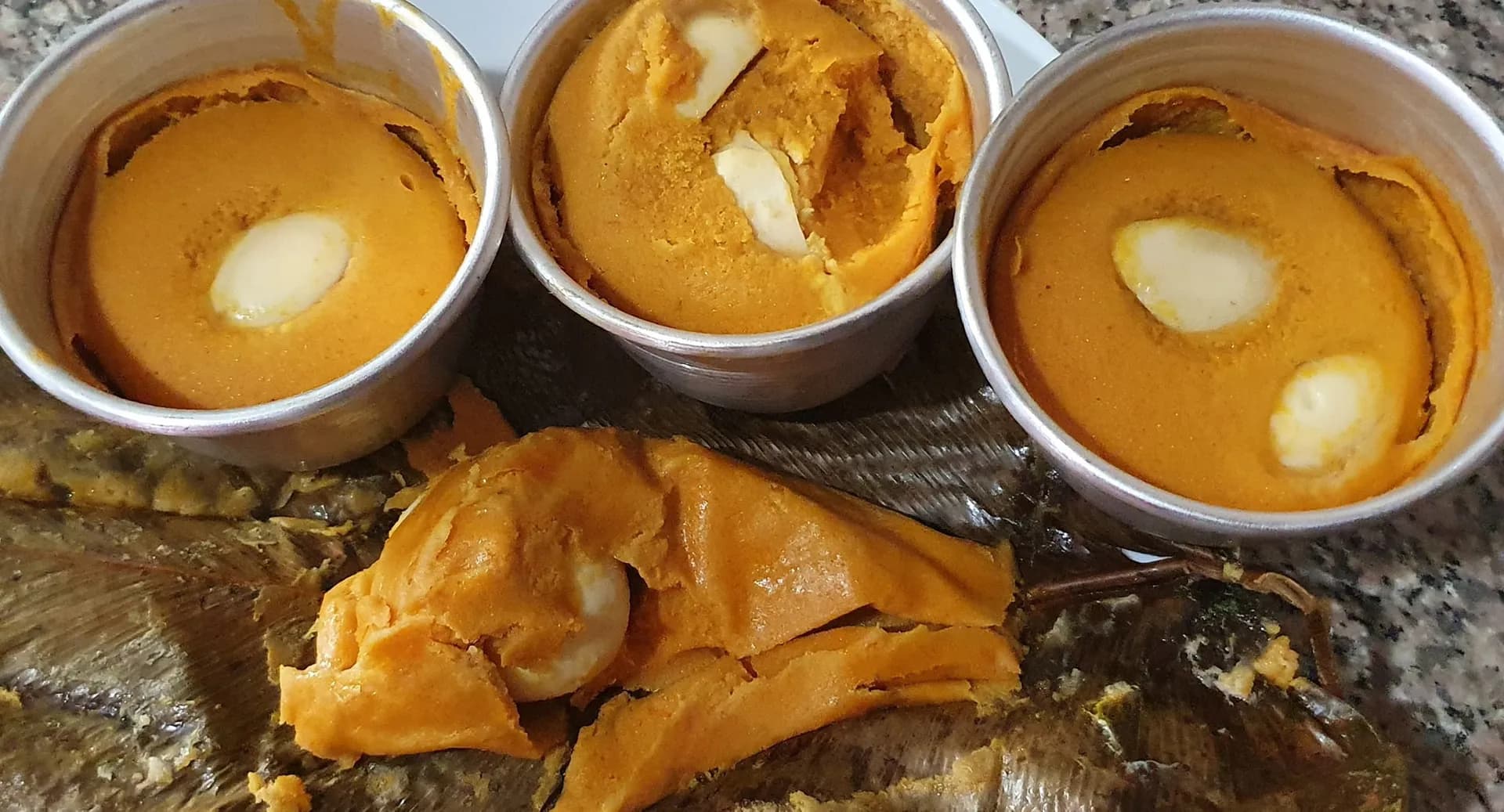
Moi moi is steamed bean pudding, and it is among the small group of Nigerian dishes that turn up everywhere: at breakfast, at parties, at weddings, in lunchboxes, beside jollof rice, and on its own. Black eyed peas or brown beans are soaked, peeled, blended with pepper and onion, seasoned, and steamed until they set.
The peeling is what most people underestimate. The bean skins have to come off before blending, because they are what stands between a smooth moi moi and a gritty one, and the quality of the blend decides the texture of the finished dish more than any other single factor. Nigerian markets have heavy duty commercial mills for exactly this reason, and home blenders often cannot manage it.
What it is steamed in changes the result and the name. Uma leaves, from Thaumatococcus daniellii, give the best flavour and cook fastest; banana leaves are the common alternative; aluminium foil and heatproof containers are the modern route. Nutmeg is the ingredient people leave out and then wonder why their moi moi does not taste like the one at the party. Egg, corned beef or bone marrow goes into the middle, and moi moi appears as a side to jollof and fried rice, as breakfast with pap or bread, and as a meal in itself.
Abom, written abomu here, is the simpler of the two main Ghanaian cocoyam leaf preparations. Where the tomato based kontomire stew is thickened with ground melon seed and cooked in a pot, abom is steamed leaves ground in an asanka with onion, pepper and ginger, finished with hot palm oil poured over the top. It is closer to a relish than to a stew.
The asanka is the tool that defines it. The ridged earthenware bowl grinds rather than purees, and everything in an abom passes through it: the aromatics first, then the salted fish, then the greens, each stage mashed into the last. That produces a coarse, uneven texture that a blender cannot reproduce and that Ghanaians would notice immediately.
It is Asante food particularly, and it is assembled rather than cooked in the ordinary sense. Plantain, egg, avocado and several kinds of fish, koobi, kakro, smoked mackerel and smoked turkey, go onto the plate around the greens, and hot palm oil is ladled over at the end. Kontomire is the proper leaf. Ghanaians abroad substitute spinach, which the source acknowledges directly, and the result is milder and softer than the cocoyam leaf gives.
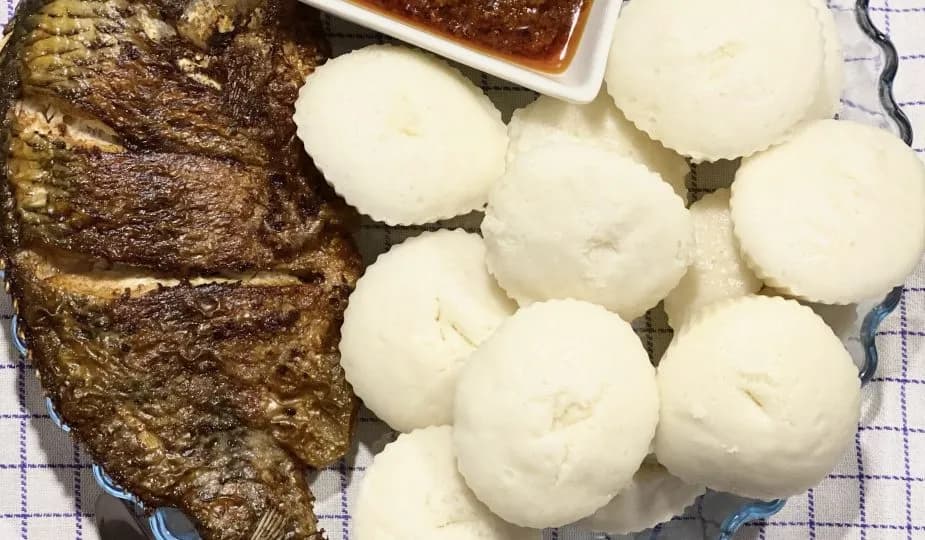
Ablo, also written abolo, is a steamed rice cake with a light, springy crumb, eaten across the coastal stretch of West Africa where Togo, Benin, Ghana and Côte d'Ivoire meet. It is white, faintly sweet, faintly sour, and built to be torn and dipped.
Its texture is the result of fermentation rather than of any raising agent alone. Rice is soaked, ground and left to rise, and the sourness that develops in that time is the difference between an ablo and a plain steamed dumpling. In Benin the cakes are steamed wrapped in banana leaf bundles, which leaves a green, faintly grassy note that a metal mould cannot give.
Ablo occupies the position that bread occupies elsewhere: it is the mild thing on the plate that the sauce is for. It is eaten with thick stews and grilled fish, and it belongs equally to a party table and a home meal. In a food culture where most starches are pounded or stirred, a steamed and leavened cake is a distinct approach, and one that Togolese, Beninese, Ghanaian and Ivorian cooks share across their borders.
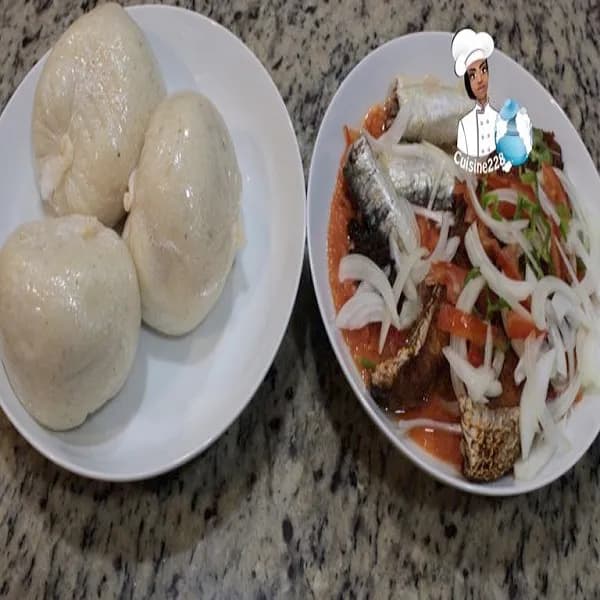
Kenkey with pepper sauce and fried fish is a complete plate rather than a dish with accompaniments, and the three parts are not interchangeable with anything else. The sour fermented maize, the raw ground pepper and the well seasoned fried fish each do something the other two cannot, and the combination is what people mean when they say kenkey.
The sourness is the axis. Maize is steeped for around two days, milled, and left to ferment for several more before any cooking happens, and the acidity that develops is what makes the plate work against fried fish. Ghanaian, Togolese and Beninese coastal cooking pairs sour starch with fried seafood repeatedly, and this is the clearest example of it. Anyone who does not already eat fermented cereals such as ogi, koko or eko tends to need a plate or two before the logic lands.
The dish carries its names with it. Komi among the Ga, dokono among the Fante, dorkunu and dokonou across Togo and Benin. It travelled further than that: to Jamaica and Guyana as dokono and konkee, and to Trinidad as paime, carried across the Atlantic with enslaved West Africans, where it survives with different fillings and the same technique.