Nous utilisons des cookies essentiels au fonctionnement du site. Nous aimerions aussi déposer des cookies de mesure d’audience et des cookies publicitaires, uniquement avec votre accord. Vous pouvez choisir séparément pour chacun. Lire notre politique relative aux cookies

Loading
Recettes
Parcourez les archives par pays, par plat et par temps de cuisson.
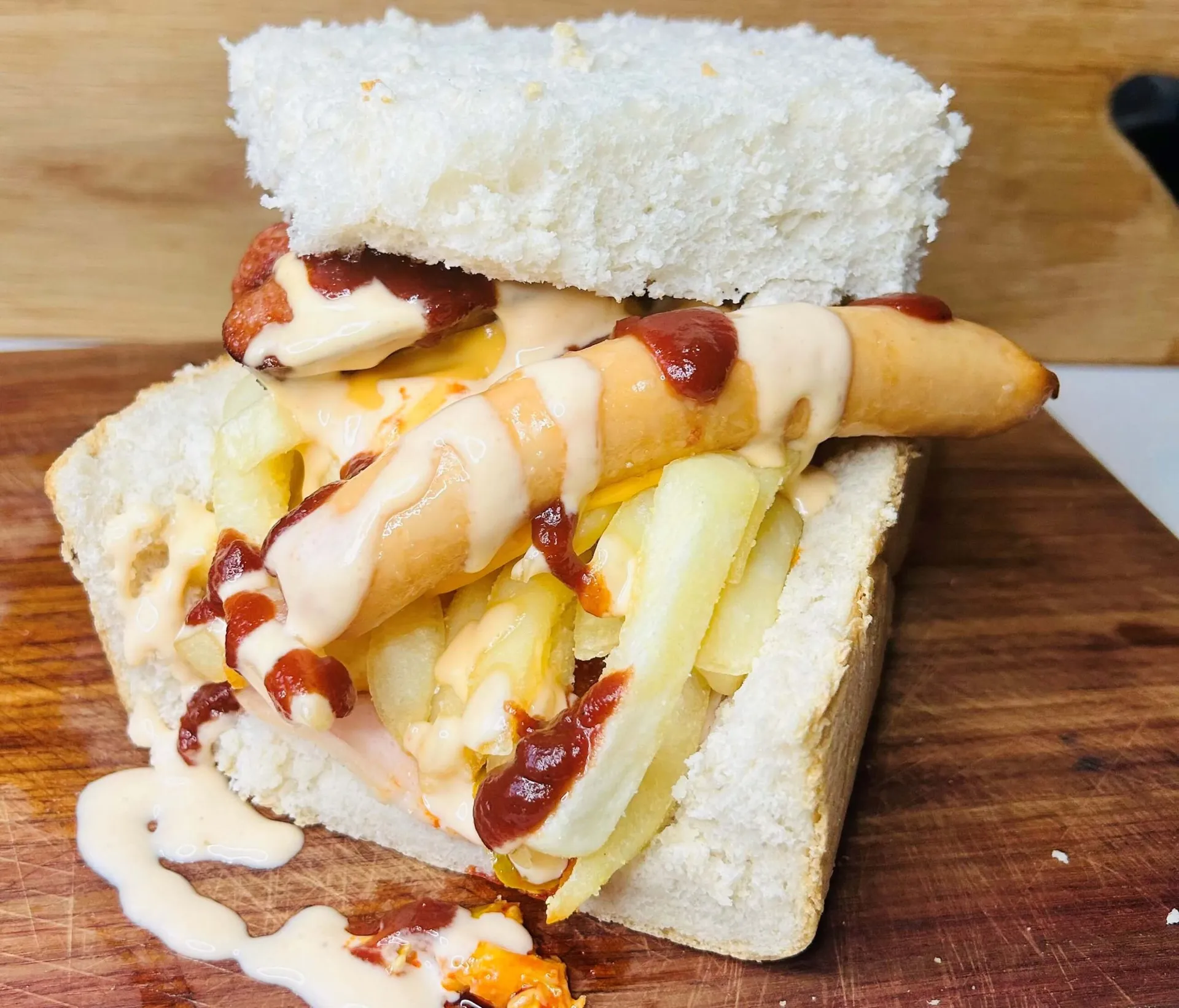
A kota is a quarter loaf of bread, hollowed out and packed with fried food. The word is township English for quarter, and that is the whole description: bread cut in four, the soft centre pulled out, and the cavity filled with chips, polony, russians, viennas, cheese, egg, atchar and sauce, then capped with the bread that was removed.
It belongs to the townships of Gauteng, where it is sold from small takeaway windows and eaten in the hand without a plate. Kota shops compete on what they will fit into a quarter loaf, and the size of the fill is a large part of the reputation. It is cheap, it is a complete meal, and it is built for people who need to eat between one thing and the next.
Atchar is what makes it South African rather than generically stuffed bread. The pickled green mango relish, oily and sour and hot, came to South Africa through Indian indenture and cuts the fried starch that dominates everything else in the cavity. Kota is often described as a version of bunny chow, and the two are related without being the same: bunny chow is Durban Indian, a hollowed loaf filled with curry, and kota is a Gauteng township form filled with fried items. They share an ancestor and are not interchangeable.
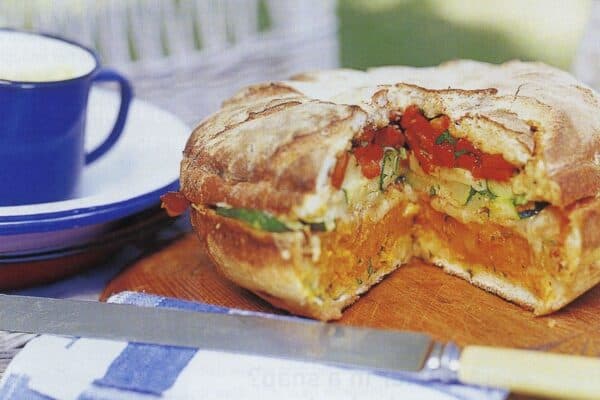
Picnic bread is a South African savoury quick bread, heavy with cheese, spring onion and bacon, bound with egg, and made to be eaten cold in a slice with nothing on it.
The category matters. It is a quick bread, raised chemically rather than with yeast, which means no proving and no kneading. Everything is mixed and baked. That is much of why it exists: it is a bread that can be made in an evening for the next day without planning.
Its association is with food carried away from home. It is described as an old recipe favoured by fishermen for their packed lunches and by schoolchildren, and the reasoning is visible in the recipe itself. It needs no butter because there is enough fat in it already. It holds together in a slice rather than crumbling. It does not dry out the way a plain loaf does. And it is dense enough that one slice is a meal rather than an accompaniment, which is exactly what you want on a boat or a long day out.
The texture is unusual for a bread. It is moist, almost pudding-like in the middle, without being heavy, and the cheese keeps it soft for days.
It is honest about what it is: nobody has ever pretended this is a low-fat recipe.
Vetkoek is a yeasted dough, flattened by hand and deep-fried until it is crisp outside and soft as bread inside. The Afrikaans name translates literally as fat cake, and the isiZulu and isiXhosa name is amagwinya. It is one of the most widely eaten things in South Africa.
Its lineage is Dutch. Fried yeast dough came to the Cape with Dutch settlers, and vetkoek belongs to the same broad family as the Dutch oliebol, the Caribbean johnnycake and Mexican sopaipillas. What happened to it afterwards is what makes it South African: it became township food and street food, sold from stalls and windows across the country, and its usual filling, curried beef mince, is itself a product of the Cape's Indian and Cape Malay influence.
It is eaten both ways round. Split and stuffed with curried mince, cheese, polony, tinned fish or slaw, it is lunch. Split and spread with syrup, honey or jam, it is a sweet snack with tea. Neither version is more authentic than the other.
Note that this page covers plain vetkoek. The filled version with beef mince curry has a separate page on this site, and the two are meant to complement rather than replace each other.
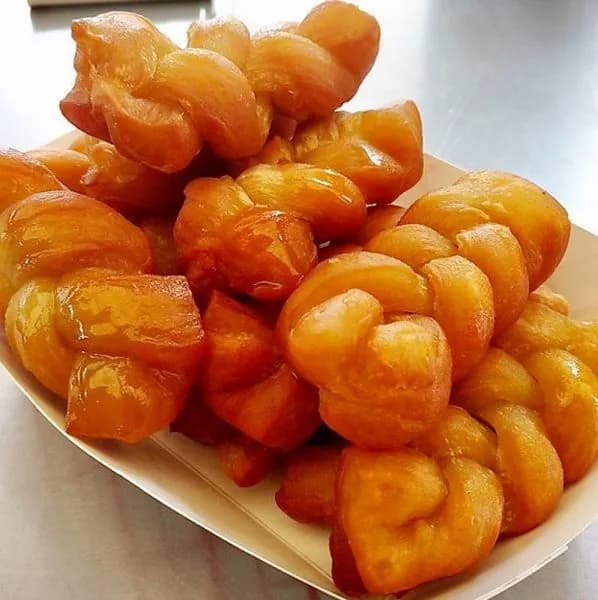
Koeksisters are plaited strips of dough deep-fried and then plunged straight into ice-cold syrup, so they stay crisp outside while the syrup soaks into the middle. They are Afrikaner, and they are one of the most recognisable South African sweets.
The temperature contrast is the whole technique and it is non-negotiable. Hot koeksister into ice-cold syrup: the sudden difference makes the pastry draw syrup deep inside while the outside stays crisp rather than dissolving. Warm syrup gives you a soggy, sticky mess. This is why the recipe makes you cool half the syrup over ice and keep the other half in the fridge, swapping when the first batch warms up, a detail that looks fussy and is actually essential.
The name has two accounts. Koek is Dutch for cake; sister is variously explained as the plaiting of two sisters' doughnuts, or as sis, the sizzle the dough makes hitting the oil. Neither is settled.
There is a second, quite different koesister, the Cape Malay version, spiced with cinnamon, ginger and aniseed, rolled in coconut, softer and more like a spiced doughnut. The two are often confused and are genuinely distinct.
The source lists half an egg, which is awkward but correct at this scale.