Nous utilisons des cookies essentiels au fonctionnement du site. Nous aimerions aussi déposer des cookies de mesure d’audience et des cookies publicitaires, uniquement avec votre accord. Vous pouvez choisir séparément pour chacun. Lire notre politique relative aux cookies
Loading
Recettes
Parcourez les archives par pays, par plat et par temps de cuisson.
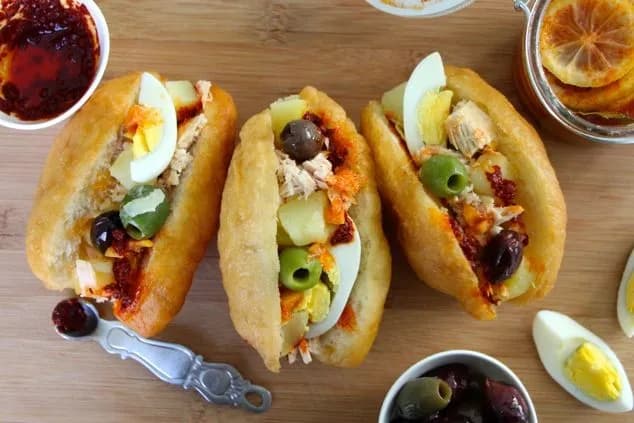
A fricassé is a small oval roll of enriched dough, deep-fried and then split and packed with tuna, potato, olives, egg and harissa. It is Tunisian street food, and it is one of the country's most recognisable things to eat.
The word does not mean what it means elsewhere. In French, a fricassée is a braise of meat in a white sauce; in Tunisia and its diaspora it means this sandwich and nothing else. That divergence is complete enough that searching the French term will not find you the Tunisian food.
The filling is the point and it is fixed by convention rather than by recipe: tuna in olive oil, cooked potato, black olives, egg and harissa, with slata méchouia, the grilled pepper and tomato salad, very often alongside. Capers and preserved lemon appear in some versions. What matters is that the bread is fried rather than baked, which gives a rich, slightly greasy roll that stands up to a wet filling.
**A significant gap in the source.** Its ingredient list contains only the dough, yeast, water, flour, egg, oil, salt. Not one of the filling ingredients it spends its article describing appears in it. The filling below has been reconstructed from that description and flagged.
**It contains eggs and fish.**
Hawawshi is pita stuffed with heavily spiced minced beef and baked until the meat cooks through and the bread crisps. It is Egyptian street food, sold across Cairo and Alexandria, where it is also known as baladi.
The story attached to it is unusually specific for a street food. It is credited to a butcher named Ahmed Al-Hawash, working in Cairo's Tawfeek Souq in the early 1970s, with the dish taking his name. The source hedges this as legend and that is the right level of confidence, it is widely repeated, plausible given how recent it is, and not documented in a way that settles it.
What makes it work is the raw filling. The meat goes into the bread uncooked, and the fat renders as it bakes, soaking into the pita from the inside while the outside crisps in the oven. Cooking the meat first would lose that entirely and give you a dry sandwich.
The wet-vegetable problem is the one thing to get right, and the source handles it well: the onion, pepper, jalapeño and parsley are processed and then drained in a sieve before they go near the meat. Skipping that step floods the bread.
Related dishes exist across the region, Lebanese arayes is the same idea with different spicing.
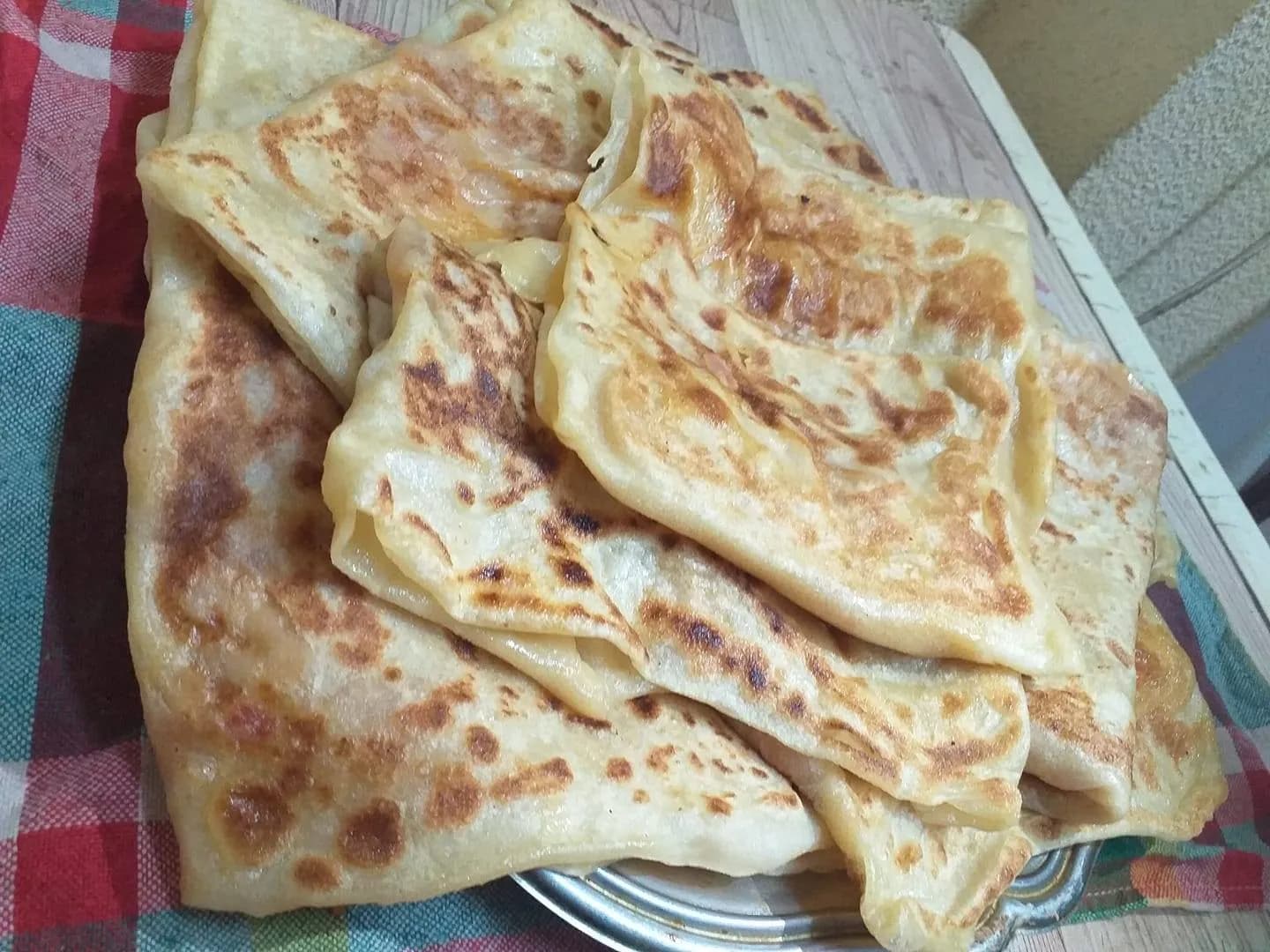
Mhajab is a stuffed North African flatbread, and the technique is what makes it. A soft dough is stretched out until it is thin enough to see through, folded in from the sides and then from the top and bottom into a square parcel around a filling, and cooked flat on a griddle. The folding creates the layers, and the layers are the dish.
It belongs to Algeria and Morocco and is closely related to the Moroccan msemen and rghaif, which use the same stretch and fold method without a filling. Mhajab is street food and it is household food for special occasions, which is a combination that usually indicates something that takes skill but not money.
The filling is conventionally a cooked mixture of onion, tomato and pepper, sometimes with meat, and the version here uses beef with potato and carrot. Vegetable fillings are as common as meat ones. It is eaten on its own, or served alongside couscous, harira and salads with mint tea. Cooked on a griddle it comes out crisp outside and soft within; baked it is softer throughout and takes longer, which is the trade the source lays out honestly.
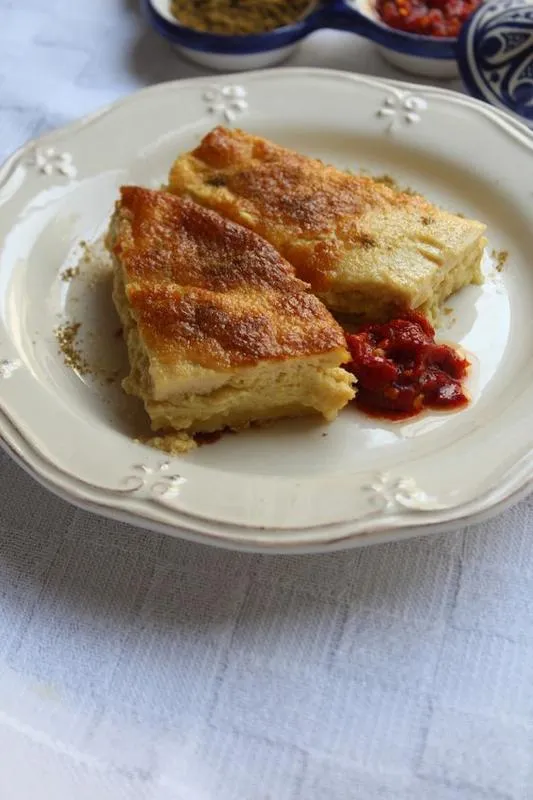
Garantita is a baked chickpea flour flan, sliced and eaten hot in a piece of baguette with cumin and harissa. It is Algerian street food in the most literal sense: sold from carts and small counters, cheap enough to be a default lunch, and eaten standing up.
Its names change across the country. Garantita in Algiers, calentica in Oran, and karantita, karen or el hami in the west. In Algiers it also goes by el kebda el beida, the white liver, and it is described without embarrassment as the poor man's sandwich, which is a statement about price rather than quality.
The origin story is a good one and should be treated as a story. It is said to come from Spanish soldiers at the fort of Santa Cruz in Oran in the 18th century, who ran out of provisions and had only chickpea flour, water and oil left, and whose cook combined them. The name is then traced to the Spanish caliente, meaning hot. The connection to Spanish chickpea cooking is real, since similar chickpea flour preparations exist across the western Mediterranean, but the specific tale of the soldiers is folklore rather than record. One rule is not negotiable: garantita is eaten hot, never cold.