

Nous utilisons des cookies essentiels au fonctionnement du site. Nous aimerions aussi déposer des cookies de mesure d’audience et des cookies publicitaires, uniquement avec votre accord. Vous pouvez choisir séparément pour chacun. Lire notre politique relative aux cookies
Loading
Recettes
Parcourez les archives par pays, par plat et par temps de cuisson.
Moukhbaza is mashed ripe banana with dried hot chilli, and the combination is the entire point. Sweet and hot together is a pairing Sudanese cooking returns to repeatedly, and moukhbaza is its most concentrated expression: nothing but banana, lemon juice and toasted chilli, with no attempt to soften the contrast between them.
The source places it in eastern Sudan. It is worth being straightforward that closely related dishes under the same name are documented in Yemen, on the other side of the Red Sea, where mukhbaza is a well established banana and chilli preparation. Eastern Sudan faces Yemen directly across that water, and the Red Sea has carried food, people and language in both directions for a very long time. Which side of it the dish began on is not something the available record settles.
Dried chilli is used across Sudanese cooking for range rather than simply for heat, and here it is toasted first, which deepens it and takes the raw edge off. Moukhbaza is served as a side or a relish rather than as a course, spread and eaten with bread, and a presentation version stuffs the mashed banana back into a halved and baked banana pepper.
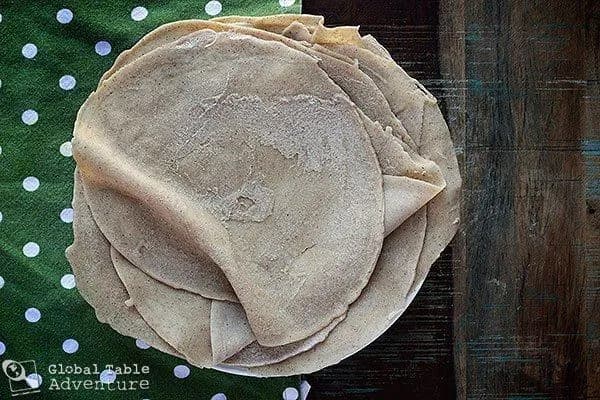
Kisra, also spelled kissra, is the fermented flatbread of Sudan, South Sudan and Chad, made from sorghum flour left to ferment overnight and spread paper thin on a hot griddle. It is a staple rather than an accompaniment, and in Sudan its production has become a home based industry supplying households that no longer make it themselves.
It comes in two forms. Kisra rhaheefa is the thin baked sheet, closely comparable to Ethiopian injera in appearance and in the lactic fermentation that produces it, though made from sorghum rather than teff. Kisra aseeda, also called aceda, is the same base cooked into a thick porridge instead. The two are eaten in different contexts and both are called kisra.
The fermentation is what determines quality, and Sudanese cooks judge it by several variables at once: the sorghum genotype, the age and strength of the starter, the temperature and the time. Lactic acid bacteria and yeast do the work, producing the acids and alcohols that give kisra its sour flavour and its aroma. A weak or young starter gives a bland bread, which is why starters are kept going and shared between households.
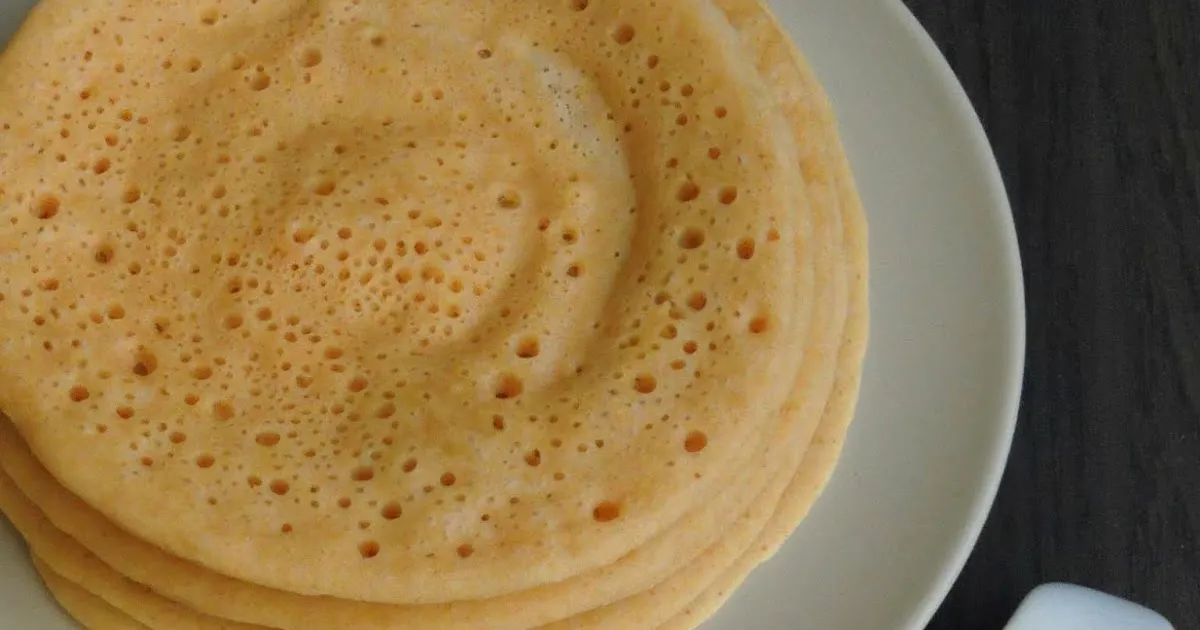
Gorraasa is a thick, spongy Sudanese flatbread cooked in a pan from a pourable batter rather than a kneaded dough. It is one of Sudan's two national breads, alongside kisra, and it is used as a tool as much as a food.
Its purpose shapes its texture. A round of gorraasa goes under stewed meat or a saucy dish, and pieces are torn off to pick food up, so it needs to be soft enough to tear cleanly and springy enough not to disintegrate under sauce. That is why it is thick and slightly elastic rather than crisp or brittle. It is often eaten with damaa, the Sudanese meat and tomato stew, in a combination known as gorraasa be dama.
Two things in the method are worth taking seriously. The batter must be thick, pancake-batter thick, because a thin one will not hold the bubbles that give the bread its sponginess. And it is cooked on one side only, over medium heat, until the top dries out completely. The heat needs watching: too high and the base burns before the top sets.
The source is emphatic about salting the batter properly, and it is right. Gorraasa made without enough salt is bland in a way that no accompaniment fixes, because there is nothing else in it.
Dried white beans cooked until tender, then finished with red onion and sliced tomatoes into a thick, soupy stew. It is Malagasy, and it is served everywhere on the island.
It is laoka, which is the useful word here. In Malagasy eating, rice is the meal and laoka is whatever accompanies it, the thing that goes on top of, or beside, a large plate of rice. Tsaramaso is one of the most popular laoka in the country, and it is eaten as a matter of course rather than as an occasion dish.
It is very often not vegetarian. Zebu meat, the humped cattle that are central to Malagasy life, makes it hen'omby sy tsaramaso, and pork makes it tsaramaso sy henakisoa. The shank is the cut the source recommends. This version is the plain one, which is also widely eaten.
The technique in the recipe is worth noting: the beans are cooked separately in water, seasoned only at the end, and a cup of their cooking liquid is kept back. That liquid is what the finished stew is loosened with, and it carries starch and flavour that plain water would not.
The source compares it to cassoulet, which is a reasonable shorthand, beans and meat cooked long and slow, though the seasoning is entirely different.