Nous utilisons des cookies essentiels au fonctionnement du site. Nous aimerions aussi déposer des cookies de mesure d’audience et des cookies publicitaires, uniquement avec votre accord. Vous pouvez choisir séparément pour chacun. Lire notre politique relative aux cookies

Loading
Recettes Nigeria
De Gullisuwa à Nigerian Buns, de Fluffy Pancakes à Nigerian Egg Roll. Toute la cuisine Nigeria, telle qu'on la prépare chez soi.
Oyster mushrooms grilled and tossed in suya spice. It is a plant-based version of the Nigerian street food, and it works better than most meat substitutions do.
**The traditional suya spice contains ground peanuts, and this recipe includes them.** The source flags it and offers to leave them out, which is honest, but it is worth stating clearly, because a peanut allergy and a suya spice blend are a genuinely dangerous combination and the name gives no warning.
Suya proper is skewered beef, ram or chicken rubbed in yaji, the spice blend of ground roasted peanuts, ginger, cayenne, garlic, onion powder and paprika, and grilled over open coals. It is Hausa in origin, from northern Nigeria, and it is sold across Nigeria, Cameroon, Niger, Ghana and parts of Sudan. Kyinkyinga is the Ghanaian name, agashe the Sudanese.
Oyster mushrooms are the right substitution and not an arbitrary one. Shredded, they have a fibrous, layered structure that genuinely resembles pulled meat, they take on the dry rub readily, and they char well. Most vegetables do neither.
The source's method is very compressed, one step reads "put in a preheated medium", with the word oven missing, and has been filled out below.
The thick, risen pancake is a North American and British form rather than an African one, and the source for this recipe says so directly: it describes itself as a basic UK recipe. It is included here as a plain reference version, not as a dish with a claim on the continent.
That distinction matters because Africa has its own pancakes and they are not this. The Nigerian pancake, known colloquially as diet, is thin, dense and deliberately savoury, carrying onion and ground pepper in the batter alongside the sugar. Hausa masa is a fermented rice cake, spongy and slightly sour, cooked in a pan of round wells. Ethiopian injera is a fermented teff flatbread that functions as a plate. Each of those is a distinct thing with its own technique and its own place at a table.
What this recipe offers is the baking powder raised, egg and milk enriched, butter cooked pancake that most of the world now recognises from breakfast menus. It is genuinely good and genuinely simple, and there is no reason not to make it. There is also no reason to describe it as African cooking, and the honest position is to present it as what it is.
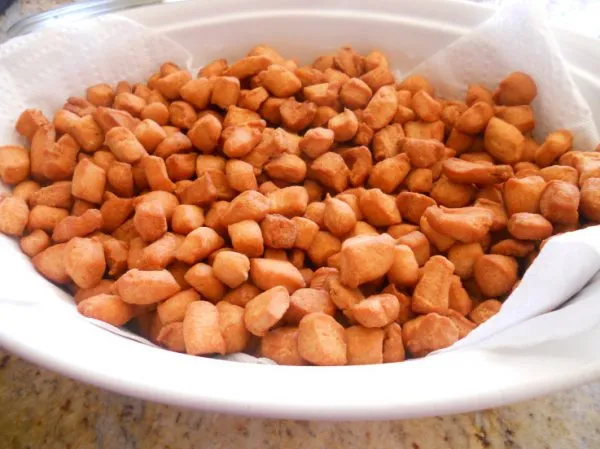
Nigerian buns are fried dough balls with a crunchy outer crust and a soft, cake like interior. They sit alongside puff puff and chin chin in the small group of fried snacks that account for most of what Nigerians eat between meals, and the differences between the three are understood precisely by anyone who grew up with them.
Buns are the rich one. Where puff puff is yeast raised and made from almost nothing, buns use baking powder for lift and include egg, butter and milk, which produces a denser, sweeter, more substantial thing with a genuinely crunchy shell. They also absorb less oil in the frying, which is a real practical advantage and a point people make in their favour.
They are everywhere: sold from roadside trays and by hawkers, made at home for children after school, brought to parties and picnics, and eaten with tea at breakfast. The flavouring is open, with nutmeg the most common and cinnamon and vanilla both standard, and every household has a version that is slightly sweeter or slightly denser than the next. They are best hot and are still good at room temperature, which is most of what a snack needs to be.
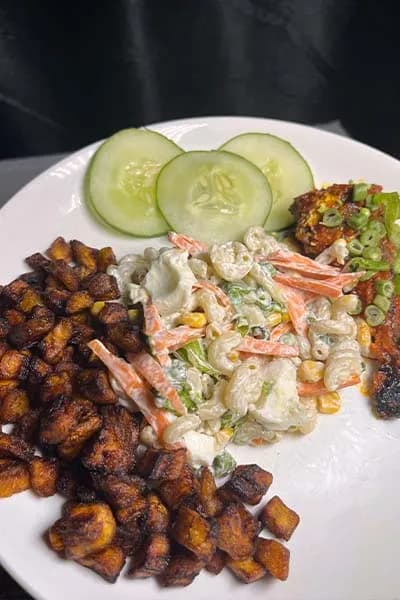
The mayonnaise dressed vegetable salad is a fixture of the Nigerian party table, and it is worth being precise about what that means, because it is not a salad in the European sense at all. There are no leaves at the centre of it. It is built on cooked vegetables, sweetcorn, egg and sometimes macaroni or baked beans, bound in mayonnaise and evaporated milk, and it is served cold in a large bowl alongside jollof rice and fried plantain.
It arrived through colonial and post independence British influence on Nigerian catering, and it has been thoroughly domesticated since. The evaporated milk in the dressing is the clearest marker of that: it is not a British addition, and it gives the dressing a sweetness and a thinner consistency than mayonnaise alone. Nigerians of a certain age associate it directly with owambe, the large celebration parties where the food is served in quantity.
This particular recipe is a contemporary quick version rather than a documented traditional dish. It uses macaroni, carrot, peas, sweetcorn, lettuce and egg with a mayonnaise and milk dressing, and it is presented by its author as an everyday meal rather than as party food. What can be said with confidence is that it belongs to that broader Nigerian salad practice; what cannot be established from the source is any particular lineage for the recipe itself.