Nous utilisons des cookies essentiels au fonctionnement du site. Nous aimerions aussi déposer des cookies de mesure d’audience et des cookies publicitaires, uniquement avec votre accord. Vous pouvez choisir séparément pour chacun. Lire notre politique relative aux cookies

Loading
Recettes Nigeria
De Oha Soup à Ayamase Stew, de Ofe Ugba à Foufou Powder. Toute la cuisine Nigeria, telle qu'on la prépare chez soi.
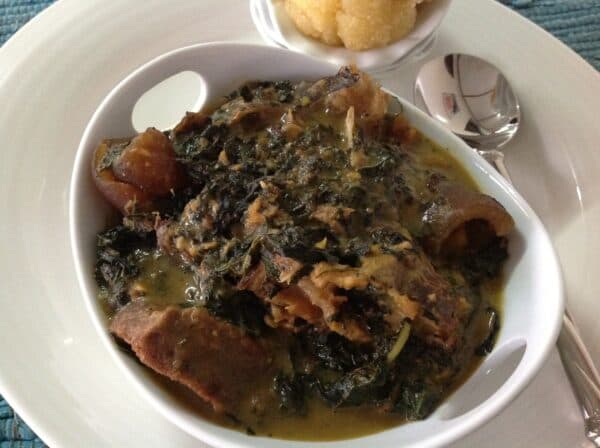
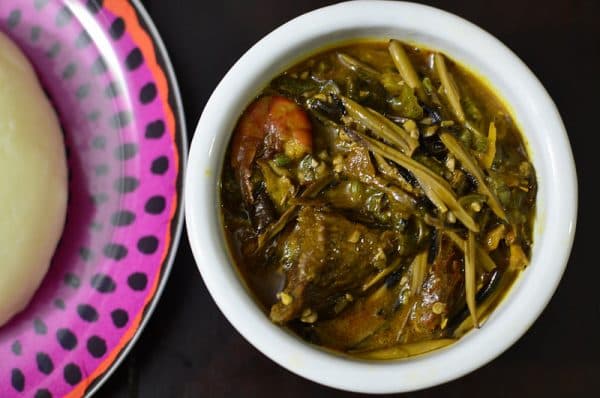
Ofe Onugbu is the bitter leaf soup of the Igbo people of southeastern Nigeria, and its whole character rests on how much bitterness is left in the leaf.
Onugbu is Vernonia amygdalina, bitter leaf, and it is genuinely bitter, unpalatably so if used straight. The preparation therefore begins with washing and squeezing the leaves repeatedly until most of that bitterness is drawn out. How far to go is a judgement, and it is where cooks differ: too little and the soup is harsh, too much and you have removed the thing the soup is named for. Some bitterness should remain.
Cocoyam is the traditional thickener. The corms are boiled, peeled and pounded to a smooth paste, then dropped into the pot in small lumps that dissolve as it simmers, giving the soup its heavy, slightly sticky body.
Palm oil, assorted beef including shaki, stockfish and dried fish, crayfish and ogiri Igbo make up the rest.
Washed bitter leaf is sold ready-prepared in African grocers, which removes the most laborious and most judgement-dependent step.
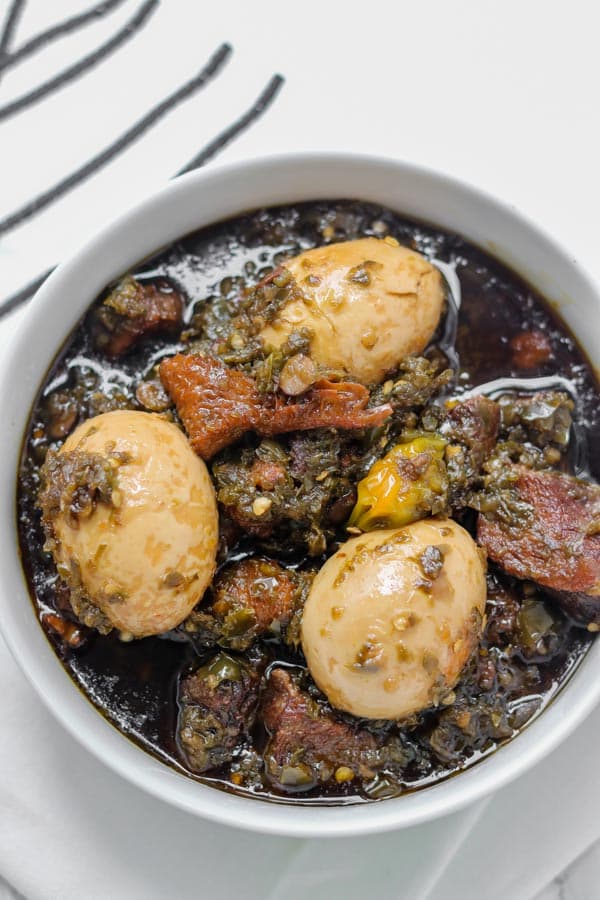
Ayamase is the green pepper stew of southwestern Nigeria, known widely as designer stew, and it is the sibling of ofada stew rather than a version of it. The difference is the pepper: ofada uses red bell peppers and tomatoes and comes out red; ayamase uses green bell peppers and unripe scotch bonnets and comes out dark green.
Bleached palm oil is what defines the technique. The oil is heated until it stops being red and turns clear, which changes its flavour entirely, removing the sweetness and leaving something deeper and more savoury. It is a step that fills a kitchen with smoke and it cannot be skipped without producing a different sauce.
The rest is southwestern Nigerian cooking at full strength: locust beans for fermented depth, ground crayfish, assorted meat including tripe and cow skin, and whole hard eggs that sit in the sauce and take on its flavour. The sign that it is finished is the oil floating to the surface. It is served with ofada rice, the local short-grain rice, or with white rice or rice and beans, and it appears at parties and in restaurants as much as at home.
Ofada stew is the Yoruba stew served with ofada rice, and it is regularly confused with ayamase, including, as the source cheerfully admits, by people who have been eating both for years.
The distinction is real and it is about the pepper. Ayamase, the green bell pepper stew also called designer stew, is built on green peppers and comes out dark olive. Ofada stew proper uses red peppers and tomatoes and is red. Both use bleached palm oil, both carry assorted meat and iru, and both are served with the same rice, which is exactly why the confusion is so widespread.
Buka stew is a third relative in the same family, which does not help matters.
The rice is the fixed point. Ofada is a local unpolished short-grain rice with an earthy, slightly fermented aroma that people either love or find odd. Its strong flavour is what these stews are built to stand up against, a delicate sauce would disappear next to it.
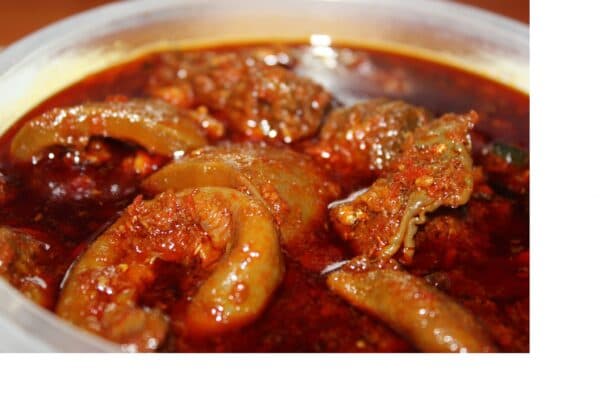
Assorted meats are the other constant: beef, shaki, ponmo, offal, and locust bean for depth.
It is traditionally served wrapped in leaves.
Ayamase is the green pepper stew of southwestern Nigeria, known almost as widely by two other names, ofada sauce, after the rice it is served with, and designer stew, which is what Lagos took to calling it.
It is defined by two things that would be faults in almost any other stew. The peppers are green rather than red, which gives the sauce its unusual dark olive colour. And the palm oil is deliberately bleached, heated until it stops smoking and loses its red pigment, which strips out the characteristic palm flavour and leaves something nuttier and smokier behind. That bleaching step is the whole signature of the dish, and a version made with unbleached oil is a different sauce.
Around that sit iru, the fermented locust bean that carries the deep savoury note, assorted meats including offal, and boiled eggs, which are close to obligatory.
The name points to a person. Ayamase is traced to Ikenne-Remo in Ogun State and to a woman remembered as Mrs Felicia, Iya Mase, the wife of Mase, who is credited with the dish. It travelled from there into Lagos party food, where its reputation as something special was made.
It is served with ofada rice, the short, unpolished local rice whose earthy flavour is the intended partner.