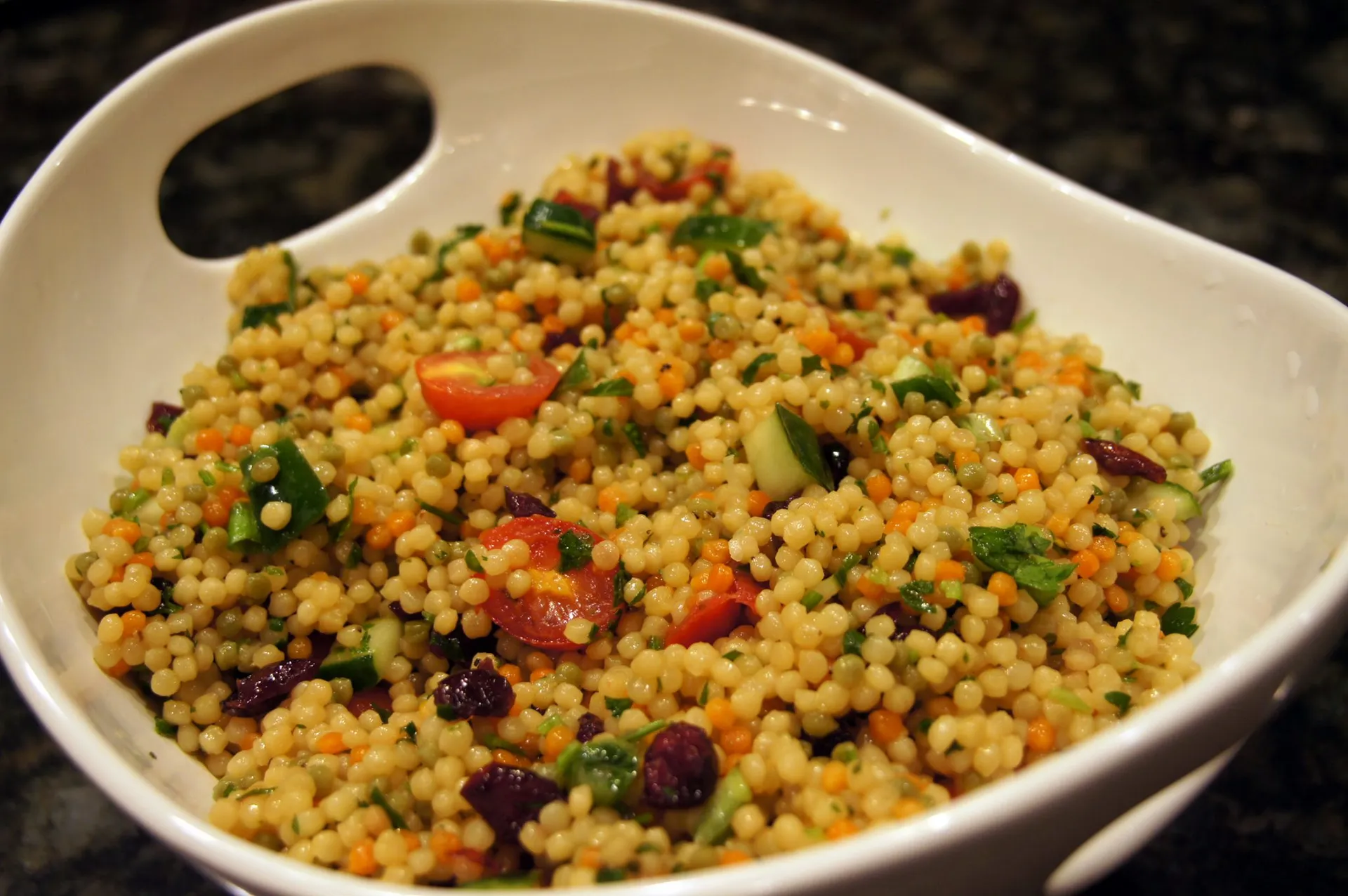
Moroccan Couscous Salad
50 minEasy


Cookies sur African Food Network
Nous utilisons des cookies essentiels au fonctionnement du site. Nous aimerions aussi déposer des cookies de mesure d’audience et des cookies publicitaires, uniquement avec votre accord. Vous pouvez choisir séparément pour chacun. Lire notre politique relative aux cookies

Parcourez les archives par pays, par plat et par temps de cuisson.
This is couscous with roasted vegetables, chickpeas, raisins and almonds, dressed with lemon, cumin and olive oil. It is a salad in the sense of being served at room temperature rather than a leafy one: the couscous is the bulk of it and the vegetables are folded through. Couscous was first made by the Amazigh people of North Africa, who worked out how to turn wheat into fine granules, and it remains a staple across Morocco, Algeria, Tunisia and Libya. Moroccan couscous is the smallest of the common grades, finer than Israeli or Lebanese couscous, and it is what this recipe uses. The technique is absorption rather than steaming. Hot broth is poured over the dry couscous, which has been tossed with olive oil and turmeric, and it is covered and left for five minutes. The raisins go in during that time so the residual heat plumps them. Traditional Moroccan couscous is steamed repeatedly in a couscoussier, which produces a lighter grain; this is the quick domestic method. The vegetables are roasted separately and folded in, which keeps them caramelised rather than steamed into the grain.
50 minEasyMorocco · Moroccan
Recette de Debby · Africook
Rien ici pour le moment
Tout effacer