Nous utilisons des cookies essentiels au fonctionnement du site. Nous aimerions aussi déposer des cookies de mesure d’audience et des cookies publicitaires, uniquement avec votre accord. Vous pouvez choisir séparément pour chacun. Lire notre politique relative aux cookies

Loading
Recettes Libya
Parcourez les archives par pays, par plat et par temps de cuisson.
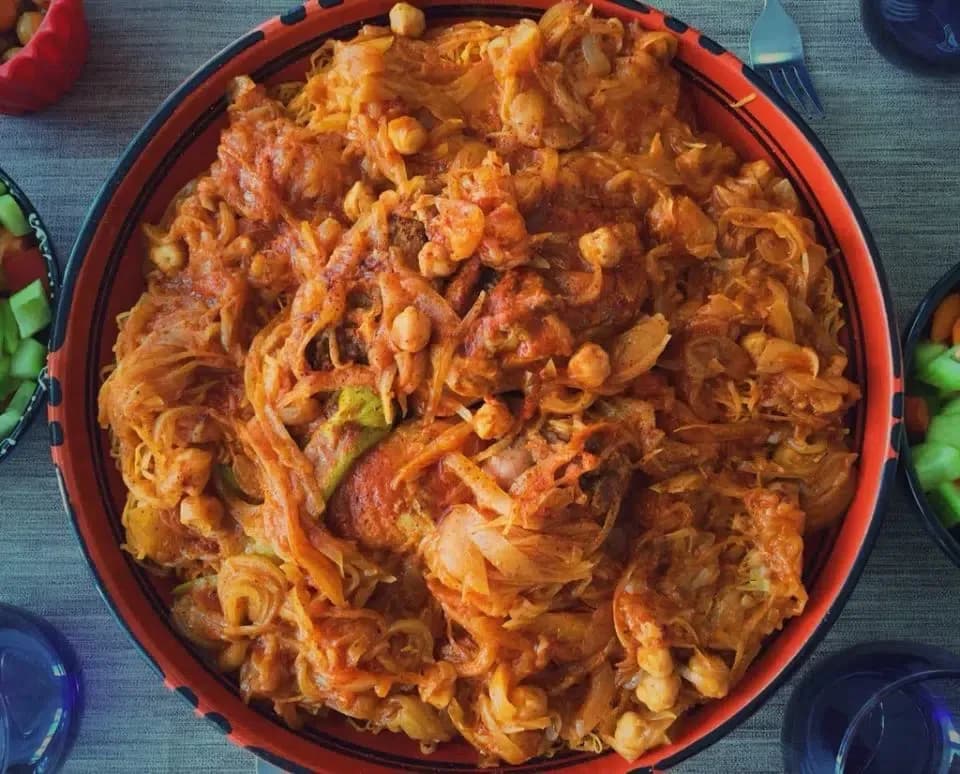
Rishta is Libyan pasta, and the important thing about it is that it is steamed rather than dropped into water. Fresh noodles are cut fine, set in a couscoussier over a sauce, and cooked in the rising steam, which is the same method Libya and the rest of the Maghreb use for couscous. That single decision separates rishta from every Italian pasta it superficially resembles.
The sauce beneath is busla, built on a large quantity of onion cut into thin wings, cooked down with chickpeas, cinnamon and cloves. Lamb goes in with tomato paste and a warm spice mix of turmeric, ginger, cinnamon, black pepper and chilli. In Tripoli, where the dish is most closely associated, it appears under the names rishdat cascas and rishda imbaukha, meaning steamed rishda.
The wider North African context is worth knowing. Dry meat called gedid, salted and sun cured, is used across the region to give dishes a smoky depth, and its use is generally traced to Amazigh practice. Rishta is also easily confused with makaruna imbaukha, another Libyan steamed pasta, which is made with dry angel hair rather than fresh cut noodles. The two look similar on a plate and are made from different things.
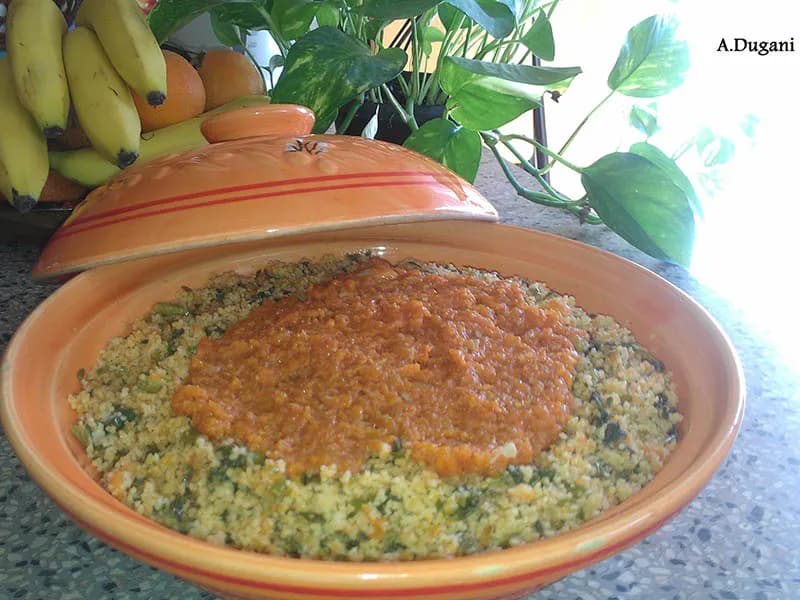
Aslooz is a Libyan couscous dish named after a plant, and the plant is the reason it belongs to a season rather than to a calendar. Aslooz is a wild weed that grows across the countryside and the mountain regions of western Libya, gathered rather than farmed, and harvested in a narrow window through January and February.
It is picked from roadsides and hillsides in the Nafusa mountains and the western districts, and only the tender twigs and flowering branches are used. Because it grows wild and its season is short, aslooz has never been a commercial crop, and it is effectively unavailable outside Libya. Libyan families abroad substitute, most often asparagus with dill, sometimes carrot with cumin leaves, and this recipe is written that way.
Everything about it is plain: steamed couscous, a tomato base, a wild green and a carrot sauce sharpened with lemon and chilli. Libyans describe it as cheap and cheerful and treat it as a family dish, made and eaten together rather than served to guests. The couscous is steamed over the greens so it takes their flavour from below, which is the technique that separates it from a couscous simply mixed with vegetables, and it is what a Libyan cook would notice first if it were skipped.
Couscous is the national dish of Libya, as it is of Algeria, Morocco, Tunisia and Mauritania, and the Libyan version has its own clear identity within that shared Maghreb tradition.
The first thing worth clearing up is what couscous actually is. It is not a grain. It is semolina, granules of durum wheat rolled and coated with finer flour, which makes it closer to a very small pasta than to rice or barley. That matters for cooking it, because it is steamed rather than boiled.
The Libyan preparation is built on meat, lamb or chicken, cooked with onion and a spiced tomato sauce, alongside vegetables that reliably include pumpkin and chickpeas. Pumpkin is a good marker: it appears in Libyan couscous far more consistently than in the Moroccan or Tunisian versions, and its sweetness against the chilli is much of the dish's character. The sauce runs spicier than Moroccan couscous, closer to the Tunisian end of the scale.
The steaming is the technique the dish is really about. Couscous is steamed in stages over the simmering stew below, so it takes the aroma up through it while staying separate and light rather than turning to paste.
In Libya it is described as folk heritage passed down through generations, and it is the dish for Friday lunches, weddings and gatherings.
Ka'ak is a ring-shaped bread, crisp outside and soft within, scattered with sesame seeds. It is Libyan in this version, and made across a wide stretch of the Arabic-speaking world, Egypt, Iraq, Iran, Jordan, Lebanon, Palestine and Syria all have their own.
The shape is what defines it. Ka'ak is formed into a large ring, bigger and thinner than a bagel, which is why street vendors across the region can carry stacks of them on a pole or a cart. In Libya it is eaten at breakfast alongside hummus and falafel, and it comes in savoury and sweet versions.
The name travels further than the shape does. Ka'ak, sometimes kahk or kahqa, covers a whole family of baked goods across the Arabic-speaking world, from this ring bread to the small filled Egyptian cookies eaten at Eid, which are a completely different thing. The word means something closer to "baked good" than to any specific item.
One technique in this recipe is worth borrowing for other breads. A tray of water is placed in the bottom of the oven while it heats, so the loaves bake in a steamy environment. Steam keeps the crust soft for the first minutes, letting the bread rise fully before the surface sets, and then produces a thin, crisp finish.