Nous utilisons des cookies essentiels au fonctionnement du site. Nous aimerions aussi déposer des cookies de mesure d’audience et des cookies publicitaires, uniquement avec votre accord. Vous pouvez choisir séparément pour chacun. Lire notre politique relative aux cookies
Loading
Recettes Algeria
Parcourez les archives par pays, par plat et par temps de cuisson.
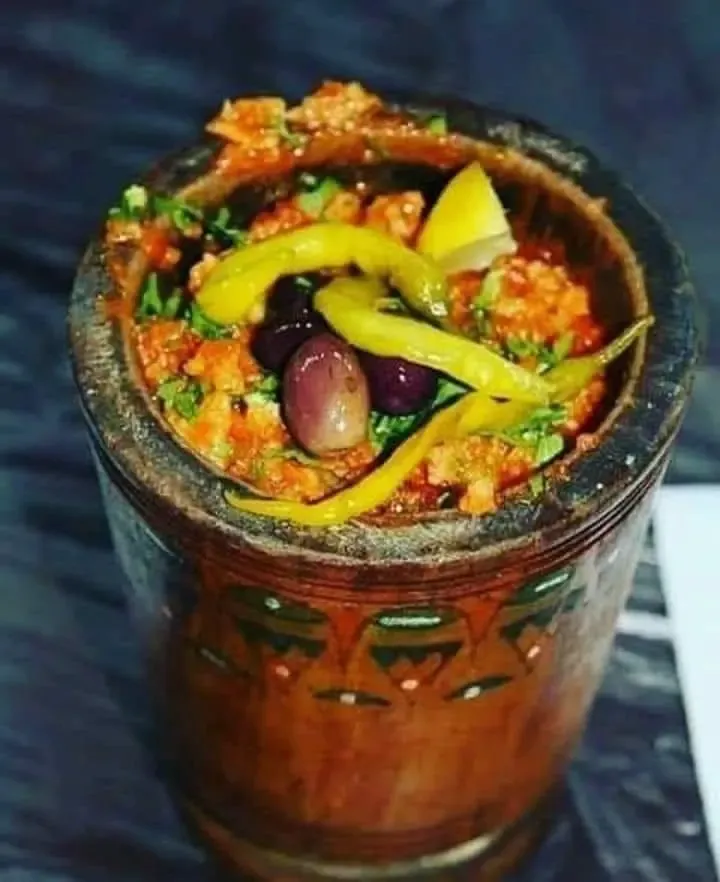
Zviti is a very hot Algerian dish from Bou Saada in M'Sila province, and it is defined as much by how it is served as by what goes into it. A semolina flatbread called rakhsis is crumbled into a tall wooden mortar, the mehrez, along with grilled peppers, tomatoes, garlic and a large quantity of chilli, and everything is crushed together with a wooden pestle.
The mortar then goes to the table. Zviti is not portioned onto plates: everyone gathers around the mehrez and eats directly from it, and in some places it is presented on a special table with a hole cut in the middle to hold the pestle upright. It also goes by the name slata mehrez, which translates as the mortar salad.
The heat is the point and Algerians are entirely open about the effect. Eating zviti involves sweating and gasping, and the description of it as a fire dish is affectionate rather than a warning. Some restaurants reduce the chilli or work olive oil and butter through it to soften it, which regulars regard as missing the idea. It is eaten as an accompaniment rather than a course, with a glass of lben, the fermented buttermilk, to cool the mouth between mouthfuls.
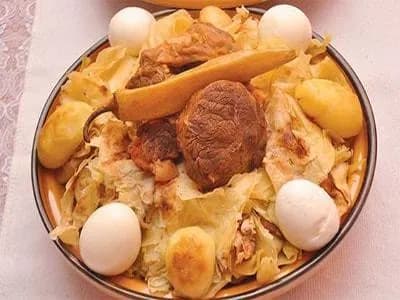
Chekhchoukha, also written chakhchoukha, is torn flatbread under a spiced meat and chickpea sauce, and the name describes the tearing. It comes from tacherchert in the Chaouia language, meaning to crumble or to tear into small pieces, and the bread is broken by hand rather than cut.
It is a Chaoui dish, from the Aurès mountains of eastern Algeria, and it spread from there into Constantine, Biskra and the rest of the country. Its origin is in shepherds' food, the substantial thing eaten on returning home on cold winter nights, and it kept that character even as it became a dish for festive occasions and celebrations rather than everyday eating.
The bread is rougag, also called trid, a very thin round flatbread made from fine semolina. It is torn, steamed briefly to soften, then heaped on a plate and covered with marqa, the sauce of diced lamb, tomato, onion and chickpeas spiced with dried red chilli, caraway, ras el hanout, black pepper and cumin. Two versions are recognised: chakhchoukha of Biskra, which is this one, and chakhchoukha dfar, which uses a different flatbread and differs in taste and thickness. Which pot it is made in also varies, with some cities using clay and others iron.
Kesra is the Algerian flatbread: round, soft and chewy, cooked on a flat pan and marked by the rings of the pan it is cooked on. It is eaten with savoury and sweet meals alike, and it is the domestic alternative to the French baguettes that fill Algerian and Tunisian bakeries as a legacy of colonisation.
Its names change across the country. It is khobz ftir in Algiers, kesra in the east, and aghroum n'tajin in Kabylia. It is native to eastern Algeria and is traditionally made with semolina rather than plain flour, along with oil, salt and water and nothing else. This particular recipe uses all purpose flour instead, which is a departure from the traditional semolina base and will give a softer, less characteristically grainy bread.
It is unleavened. There is no yeast, no rising, only a rest of twenty minutes or so to relax the dough so it stops springing back when rolled. A heavy pan works best, and a cast iron one with embossed rings gives the circular pattern kesra is recognised by. Sesame or nigella seeds are a common addition worked into the dough. It is served alongside Algerian soups and stews, and berkoukes in particular is conventionally eaten with it.