Nous utilisons des cookies essentiels au fonctionnement du site. Nous aimerions aussi déposer des cookies de mesure d’audience et des cookies publicitaires, uniquement avec votre accord. Vous pouvez choisir séparément pour chacun. Lire notre politique relative aux cookies

Loading
Recettes
Parcourez les archives par pays, par plat et par temps de cuisson.
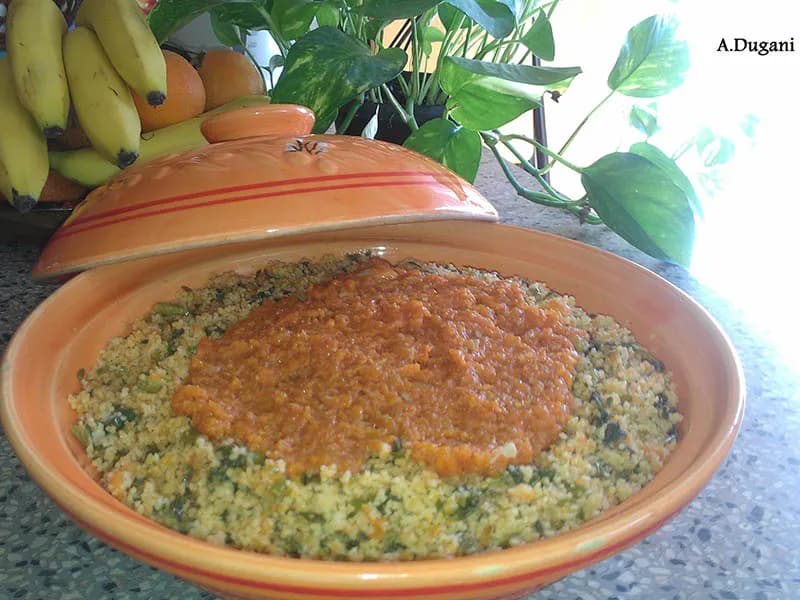
Aslooz is a Libyan couscous dish named after a plant, and the plant is the reason it belongs to a season rather than to a calendar. Aslooz is a wild weed that grows across the countryside and the mountain regions of western Libya, gathered rather than farmed, and harvested in a narrow window through January and February.
It is picked from roadsides and hillsides in the Nafusa mountains and the western districts, and only the tender twigs and flowering branches are used. Because it grows wild and its season is short, aslooz has never been a commercial crop, and it is effectively unavailable outside Libya. Libyan families abroad substitute, most often asparagus with dill, sometimes carrot with cumin leaves, and this recipe is written that way.
Everything about it is plain: steamed couscous, a tomato base, a wild green and a carrot sauce sharpened with lemon and chilli. Libyans describe it as cheap and cheerful and treat it as a family dish, made and eaten together rather than served to guests. The couscous is steamed over the greens so it takes their flavour from below, which is the technique that separates it from a couscous simply mixed with vegetables, and it is what a Libyan cook would notice first if it were skipped.
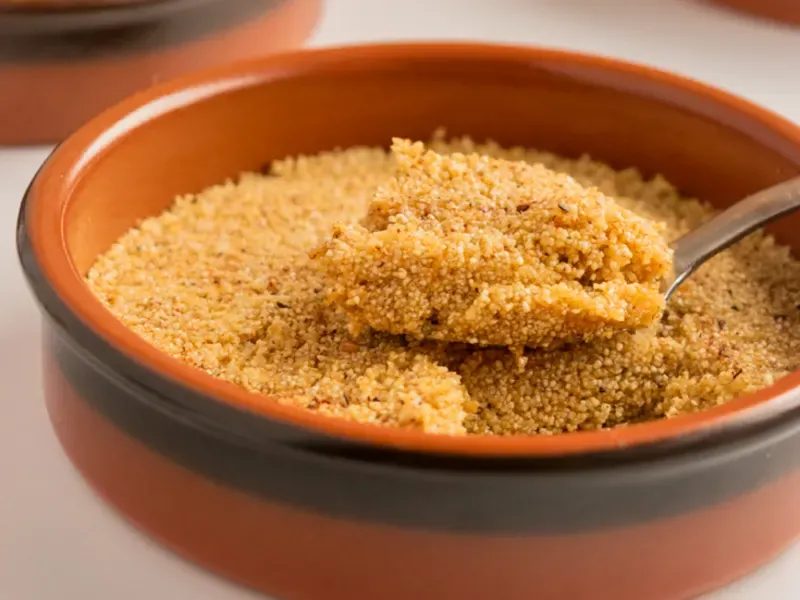
How to prepare instant couscous: boiling water or stock poured over, covered, left to steam, then fluffed. This is a technique page for a staple ingredient rather than a recipe for a dish, and it is filed as such.
Couscous is North African, specifically Berber in origin, and it is a staple across Morocco, Algeria, Tunisia and Libya. Its status was recognised by UNESCO in 2020, when the knowledge and practices around couscous were inscribed on the Representative List of the Intangible Cultural Heritage of Humanity in a joint submission by Algeria, Mauritania, Morocco and Tunisia.
It is not a grain, despite looking like one. Couscous is pasta, durum wheat semolina moistened, rolled into tiny granules and dried. Three sizes are common: Moroccan, the smallest; Israeli or pearl couscous, about the size of peppercorns; and Lebanese, the largest.
The traditional method has nothing to do with pouring boiling water on. Couscous is steamed, usually more than once, in the upper chamber of a couscoussier over a stew whose vapours flavour it as it cooks. That is how it is made for a proper meal in North Africa and the results are much lighter.
Almost all couscous sold in supermarkets is pre-steamed and dried, which is why the rehydration method here works.
Bamia is a stew of lamb, okra and tomato, and the name is simply the Arabic word for okra, which tells you where the emphasis lies.
It is eaten across an enormous area: all the Arab countries, Anatolia and Turkey, Greece, Afghanistan and Iran, with regional variations at every point. In Egypt it is a household staple and particularly associated with Ramadan, where it appears regularly on iftar tables.
The construction is straightforward. Lamb is browned and stewed with onion, garlic and tomato, seasoned with coriander and cardamom, and okra is added to cook in the sauce. It is often finished in the oven in a clay dish, which is worth doing if you have one, the even, enclosed heat suits it.
The okra question dominates how people feel about the dish. Okra releases a mucilaginous liquid when cut and cooked in liquid, which thickens the stew. Some cuisines prize this; others go to considerable lengths to avoid it. Using whole small okra rather than sliced, and not overworking it, keeps it to a minimum.
Small young pods are much better than large ones, which turn woody.
Taktouka is roasted peppers and grated tomato cooked down with onion, garlic, cumin and paprika into a thick warm salad. It is Moroccan, also popular in Algeria, and it is a mezze dish rather than a leaf salad.
The name explains the texture. It comes from the Arabic taktak, meaning to grind or pound, and the vegetables end up soft and broken down rather than crisp. That is why the source opens by pre-empting the obvious question, why a salad needs a recipe, and it is a fair point: taktouka requires cooking, and cooking is most of it.
It has regional names worth knowing. In eastern Morocco it is called flifla; in Algeria, felfla mechouia. Zaalouk, the aubergine version, is its closest sibling and works the same way.
Grating the tomatoes rather than dicing them is the technique the source recommends and it is a good one. Cutting a tomato in half and grating the cut face against a box grater extracts the pulp and leaves the skin behind in your hand, no peeling, no blanching, and a smoother result.
This dish is closely related to matbucha, the Moroccan-Jewish version, which is on this site. Matbucha is cooked longer, without onion or cumin, and the two are genuinely distinguished by community and by seasoning rather than being the same recipe under two names.