Nous utilisons des cookies essentiels au fonctionnement du site. Nous aimerions aussi déposer des cookies de mesure d’audience et des cookies publicitaires, uniquement avec votre accord. Vous pouvez choisir séparément pour chacun. Lire notre politique relative aux cookies

Loading
Recettes
Parcourez les archives par pays, par plat et par temps de cuisson.
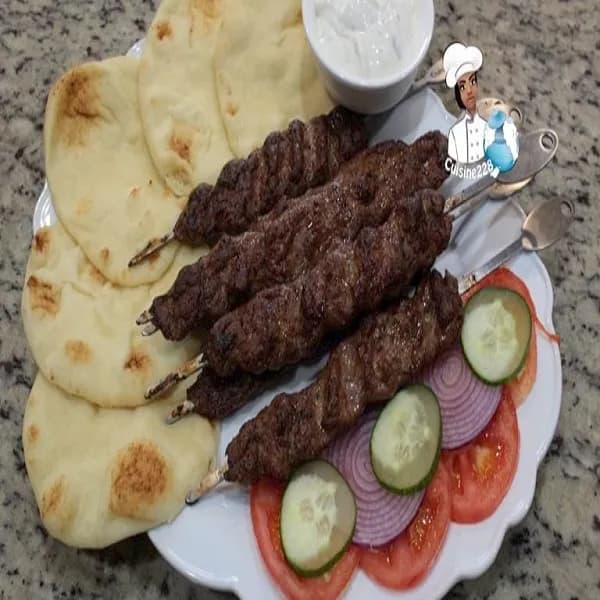
Kofta is minced meat, seasoned and shaped by hand, and it runs across an enormous stretch of the world: from the Balkans through Turkey, the Levant and Egypt, across the Arabian peninsula, into Central Asia and the Indian subcontinent, and along the North African coast. The Egyptian version is lamb or beef with onion, parsley, mint and a warm spice mix, moulded onto skewers and grilled.
Its written history is old. Recipes appear in the earliest surviving Arab cookbooks, where large ground lamb meatballs were glazed in saffron and egg yolk, a technique that later reached Europe and was known there as gilding or endoring. From the Arab world it travelled east, and nargisi kofta was served at the Mughal court in India.
In Egypt, kofta belongs to the grilled meat restaurants that exist in every town, where it is cooked alongside kebab, grilled chicken and tarb and served with rice, bread and salad. The distinction Egyptians draw between kofta and kebab is worth knowing: kebab is cubed meat on a skewer, kofta is minced meat shaped by hand. It is essentially sausage without a casing, and the comparison to a hamburger, sometimes made, misses that it is almost never served in bread.
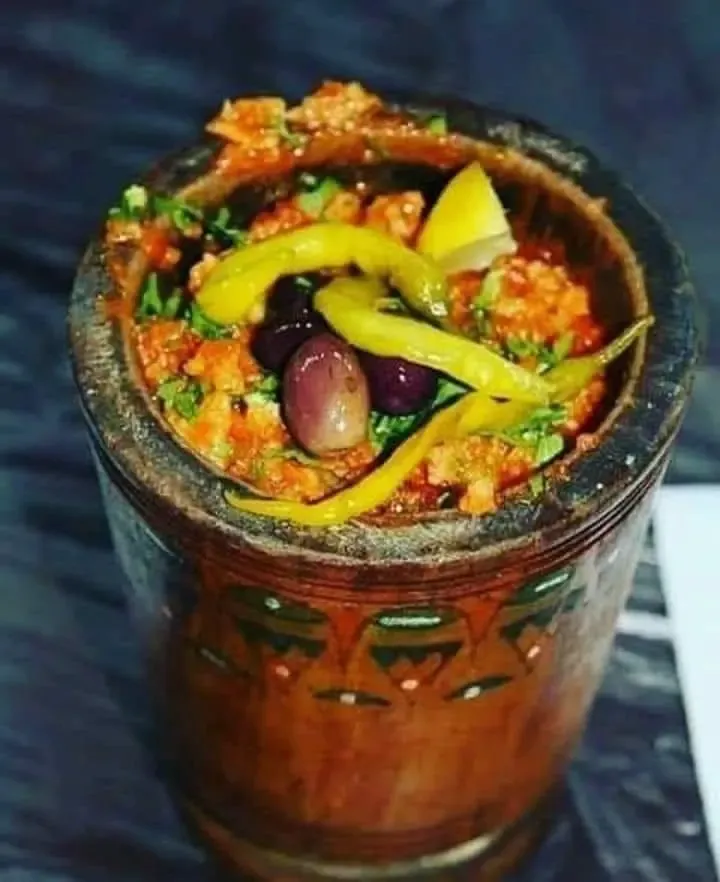
Zviti is a very hot Algerian dish from Bou Saada in M'Sila province, and it is defined as much by how it is served as by what goes into it. A semolina flatbread called rakhsis is crumbled into a tall wooden mortar, the mehrez, along with grilled peppers, tomatoes, garlic and a large quantity of chilli, and everything is crushed together with a wooden pestle.
The mortar then goes to the table. Zviti is not portioned onto plates: everyone gathers around the mehrez and eats directly from it, and in some places it is presented on a special table with a hole cut in the middle to hold the pestle upright. It also goes by the name slata mehrez, which translates as the mortar salad.
The heat is the point and Algerians are entirely open about the effect. Eating zviti involves sweating and gasping, and the description of it as a fire dish is affectionate rather than a warning. Some restaurants reduce the chilli or work olive oil and butter through it to soften it, which regulars regard as missing the idea. It is eaten as an accompaniment rather than a course, with a glass of lben, the fermented buttermilk, to cool the mouth between mouthfuls.
Lamb chops with chermoula and yellow rice is Moroccan, grilled or roasted lamb served with a fresh herb sauce and turmeric-stained rice.
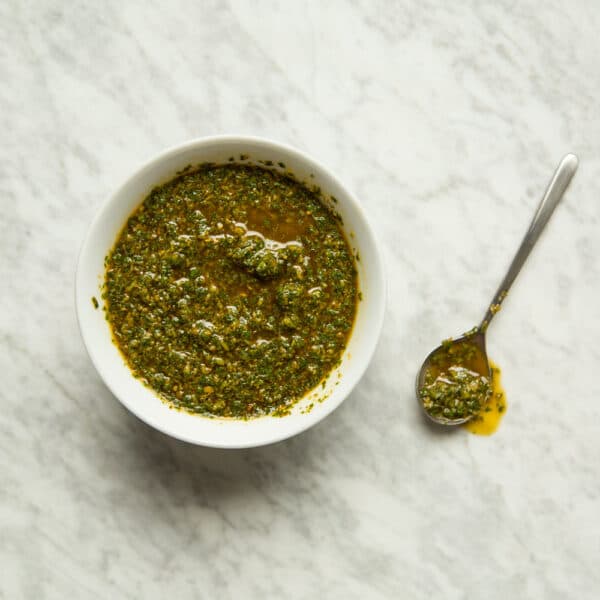
Chermoula is the part worth knowing. It is a North African sauce and marinade built on fresh coriander and parsley, garlic, cumin, paprika, lemon and oil, and its name comes from the Arabic chermel, meaning to rub or to marinate. That etymology describes exactly how it is used: rubbed into meat or fish before cooking, and often served again alongside as a sauce.
It is most associated with fish, where it is close to standard across Morocco and Algeria, but it works with lamb particularly well, the herbs and lemon cut through fat in a way that a heavier sauce would not.
Lamb runs through Moroccan cooking at every level, from long slow tagines to chops straight off a grill, and this is at the fast end of that range.
The rice is coloured and lightly perfumed with turmeric rather than saffron, which is the everyday choice, visually similar, entirely different in flavour and cost.
Taktouka is roasted peppers and grated tomato cooked down with onion, garlic, cumin and paprika into a thick warm salad. It is Moroccan, also popular in Algeria, and it is a mezze dish rather than a leaf salad.
The name explains the texture. It comes from the Arabic taktak, meaning to grind or pound, and the vegetables end up soft and broken down rather than crisp. That is why the source opens by pre-empting the obvious question, why a salad needs a recipe, and it is a fair point: taktouka requires cooking, and cooking is most of it.
It has regional names worth knowing. In eastern Morocco it is called flifla; in Algeria, felfla mechouia. Zaalouk, the aubergine version, is its closest sibling and works the same way.
Grating the tomatoes rather than dicing them is the technique the source recommends and it is a good one. Cutting a tomato in half and grating the cut face against a box grater extracts the pulp and leaves the skin behind in your hand, no peeling, no blanching, and a smoother result.
This dish is closely related to matbucha, the Moroccan-Jewish version, which is on this site. Matbucha is cooked longer, without onion or cumin, and the two are genuinely distinguished by community and by seasoning rather than being the same recipe under two names.