Nous utilisons des cookies essentiels au fonctionnement du site. Nous aimerions aussi déposer des cookies de mesure d’audience et des cookies publicitaires, uniquement avec votre accord. Vous pouvez choisir séparément pour chacun. Lire notre politique relative aux cookies
Loading
Recettes
Parcourez les archives par pays, par plat et par temps de cuisson.
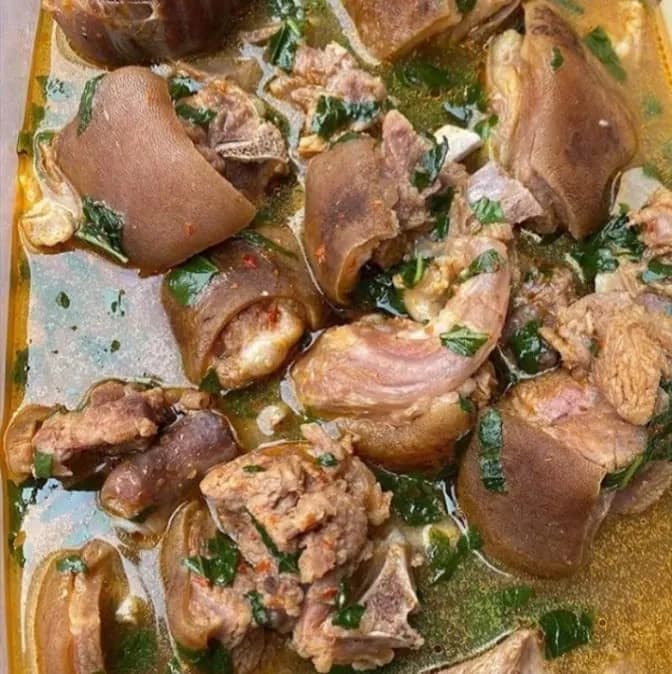
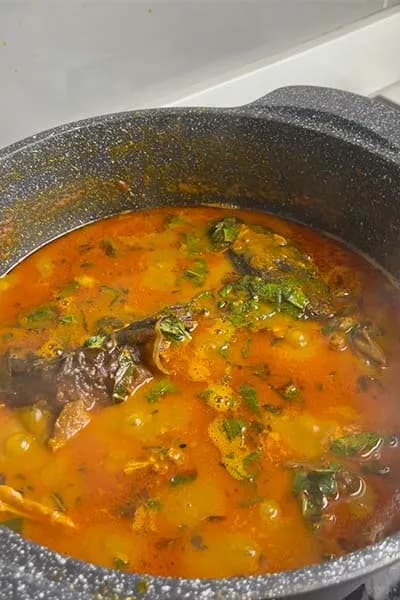
Pepper soup is a Nigerian category rather than a single recipe, and the goat meat version is among the most eaten of them. What holds the family together is the broth: clear, thin, aggressively hot and built on a specific spice blend rather than on tomato, oil or thickener. Nothing in a pepper soup is there for body.
The spice blend is what makes it. Pepper soup spice varies by region and by household but is built around African nutmeg, ehuru, uziza seed and other aromatics, and it is the one ingredient that cannot be left out or approximated. Everything else in the bowl is variable: catfish in the Delta and Rivers, goat in the north, chicken as the widely available option, assorted meat where a household is feeding a crowd.
Goat gives it a depth the lighter proteins do not. It also demands time, which is why this is not a weeknight soup unless the meat was cooked the night before or a pressure pot is involved. Pepper soup occupies a particular place in Nigerian life as restorative food, eaten when someone is unwell, cold or worn out at the end of a day, and it is served both as a first course and as a full meal with yam, plantain or rice.
Abom, written abomu here, is the simpler of the two main Ghanaian cocoyam leaf preparations. Where the tomato based kontomire stew is thickened with ground melon seed and cooked in a pot, abom is steamed leaves ground in an asanka with onion, pepper and ginger, finished with hot palm oil poured over the top. It is closer to a relish than to a stew.
The asanka is the tool that defines it. The ridged earthenware bowl grinds rather than purees, and everything in an abom passes through it: the aromatics first, then the salted fish, then the greens, each stage mashed into the last. That produces a coarse, uneven texture that a blender cannot reproduce and that Ghanaians would notice immediately.
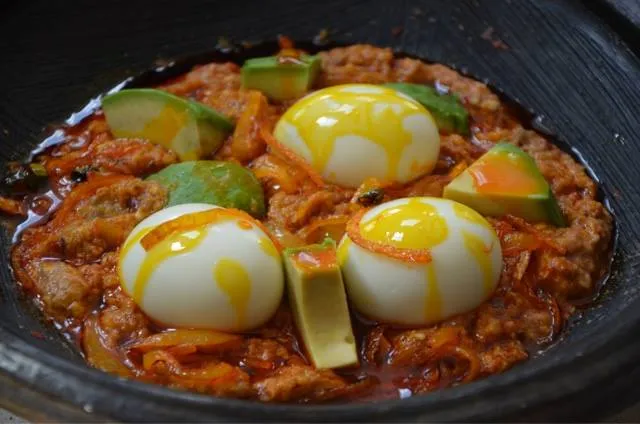
It is Asante food particularly, and it is assembled rather than cooked in the ordinary sense. Plantain, egg, avocado and several kinds of fish, koobi, kakro, smoked mackerel and smoked turkey, go onto the plate around the greens, and hot palm oil is ladled over at the end. Kontomire is the proper leaf. Ghanaians abroad substitute spinach, which the source acknowledges directly, and the result is milder and softer than the cocoyam leaf gives.
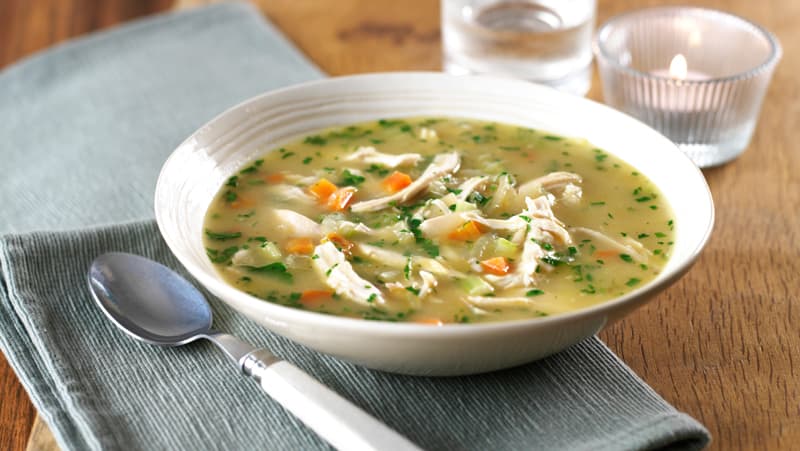
Chicken soup is chicken simmered in water with vegetables and aromatics, and it exists in more or less every cuisine that keeps chickens.
Its reputation as a remedy for colds is genuinely cross-cultural and unusually persistent. Every version of it, Jewish, Chinese, Greek, West African, Latin American, carries some form of the same claim, which is a reasonable indication that people have found it useful for a long time. Warm liquid, salt and steam all plausibly help someone with a cold feel better, whatever else is going on.
The technique is entirely about the broth. A good chicken soup is made by simmering gently rather than boiling, a hard boil emulsifies the fat into the liquid and turns it cloudy and greasy. Skimming the surface in the first twenty minutes removes the scum that would otherwise cloud it further.
Bones matter more than meat. A carcass, wings or thighs give far more body than breast, because collagen from the bones and joints is what gives broth its weight.
**Filed as Worldwide.** Chicken soup belongs to no single cuisine, and the recipe as written makes no particular national claim.
Bamia is a stew of lamb, okra and tomato, and the name is simply the Arabic word for okra, which tells you where the emphasis lies.
It is eaten across an enormous area: all the Arab countries, Anatolia and Turkey, Greece, Afghanistan and Iran, with regional variations at every point. In Egypt it is a household staple and particularly associated with Ramadan, where it appears regularly on iftar tables.
The construction is straightforward. Lamb is browned and stewed with onion, garlic and tomato, seasoned with coriander and cardamom, and okra is added to cook in the sauce. It is often finished in the oven in a clay dish, which is worth doing if you have one, the even, enclosed heat suits it.
The okra question dominates how people feel about the dish. Okra releases a mucilaginous liquid when cut and cooked in liquid, which thickens the stew. Some cuisines prize this; others go to considerable lengths to avoid it. Using whole small okra rather than sliced, and not overworking it, keeps it to a minimum.
Small young pods are much better than large ones, which turn woody.