Nous utilisons des cookies essentiels au fonctionnement du site. Nous aimerions aussi déposer des cookies de mesure d’audience et des cookies publicitaires, uniquement avec votre accord. Vous pouvez choisir séparément pour chacun. Lire notre politique relative aux cookies
Loading
Recettes
Parcourez les archives par pays, par plat et par temps de cuisson.
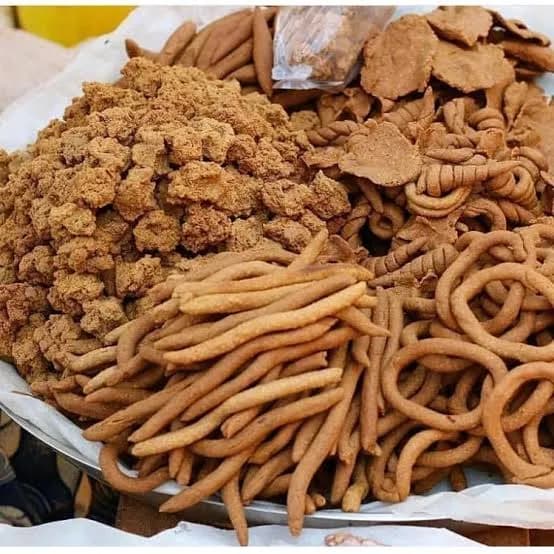
Kuli kuli is a peanut snack eaten across Nigeria, Benin, northern Cameroon and Ghana, and it is one of the most widely recognised street foods in West Africa. It is made from peanuts alone, and the technique is what makes it: the oil is deliberately pressed out of the ground paste before the remaining solids are shaped and fried.
That extraction is the point. Removing the oil leaves a dense, dry paste that fries into something genuinely crunchy rather than soft, and it also produces the frying oil as a by-product, so nothing is wasted. It is a piece of processing knowledge that predates industrial oil pressing and is still done by hand in Hausa communities in northern Nigeria, where the snack has its strongest association.
It takes different shapes in different places: small sticks, rings, flat discs and irregular pieces are all standard, and the form varies by region and by seller. English names for it, groundnut cake and peanut snack among them, are approximations rather than translations. Kuli kuli is eaten on its own, mixed into garri with sugar and water, crumbled over salad, or served alongside fura and koko. Crushed to a powder it becomes the peanut component of suya spice, which is where most people outside the region encounter it without knowing.
Kelewele is Ghanaian spiced fried plantain: ripe plantain cut into cubes, tossed in a paste of ginger, chilli, garlic and spices, rested, then fried until the outside crisps and the inside stays soft. It is one of the country's best known street foods and is sold from stalls in the evening across Accra.
The spicing is what distinguishes it, and it is worth being clear about this because the source is not. **Kelewele is not the same as aloco.** Aloco is the Ivorian name for plain fried ripe plantain, salted and nothing more, and the same dish is dodo in Nigeria and makemba in the Congo. Kelewele is marinated first, and the ginger and chilli are the entire reason it has its own name.
Ginger, hot pepper and salt are the base, and nutmeg, garlic, onion and lemon appear in most versions. The rest matters: ten to twenty minutes lets the spice paste get into the cut faces of the plantain rather than sitting on the surface. It is eaten on its own, with roasted peanuts, or alongside rice and bean dishes, and it is sometimes described as vegetarian meat for the substance it lends a plate. Traditionally it is fried in red palm oil.
Ripe plantains mashed to a paste, combined with rice flour and turmeric-infused oil, then baked in a loaf tin and sliced. The source places it in Ivory Coast, where plantain in every form is close to universal.
It is worth being clear about what this is, because the title is misleading in two directions. It is not sliced plantain roasted in an oven, which is what most people mean by baked plantain. And the recipe uses rice flour as a binder and turmeric for colour, which makes it a plantain loaf or cake, closer in construction to a steamed pudding than to a side dish. The slug says load rather than loaf, which appears to be a typo in the original; the URL has been kept exactly as it is.
One ingredient does not fit the stated origin. Chilli sambal is Indonesian and Malay, and it is not part of Ivorian cooking. It may be a substitution the contributor made for a local pepper paste, but the source does not say so, and rather than invent an explanation it has been flagged.
The source's nutritional comparisons with potato have not been carried across. What matters for cooking is that ripe plantain is sweet and starchy, and that is what makes the loaf hold together.
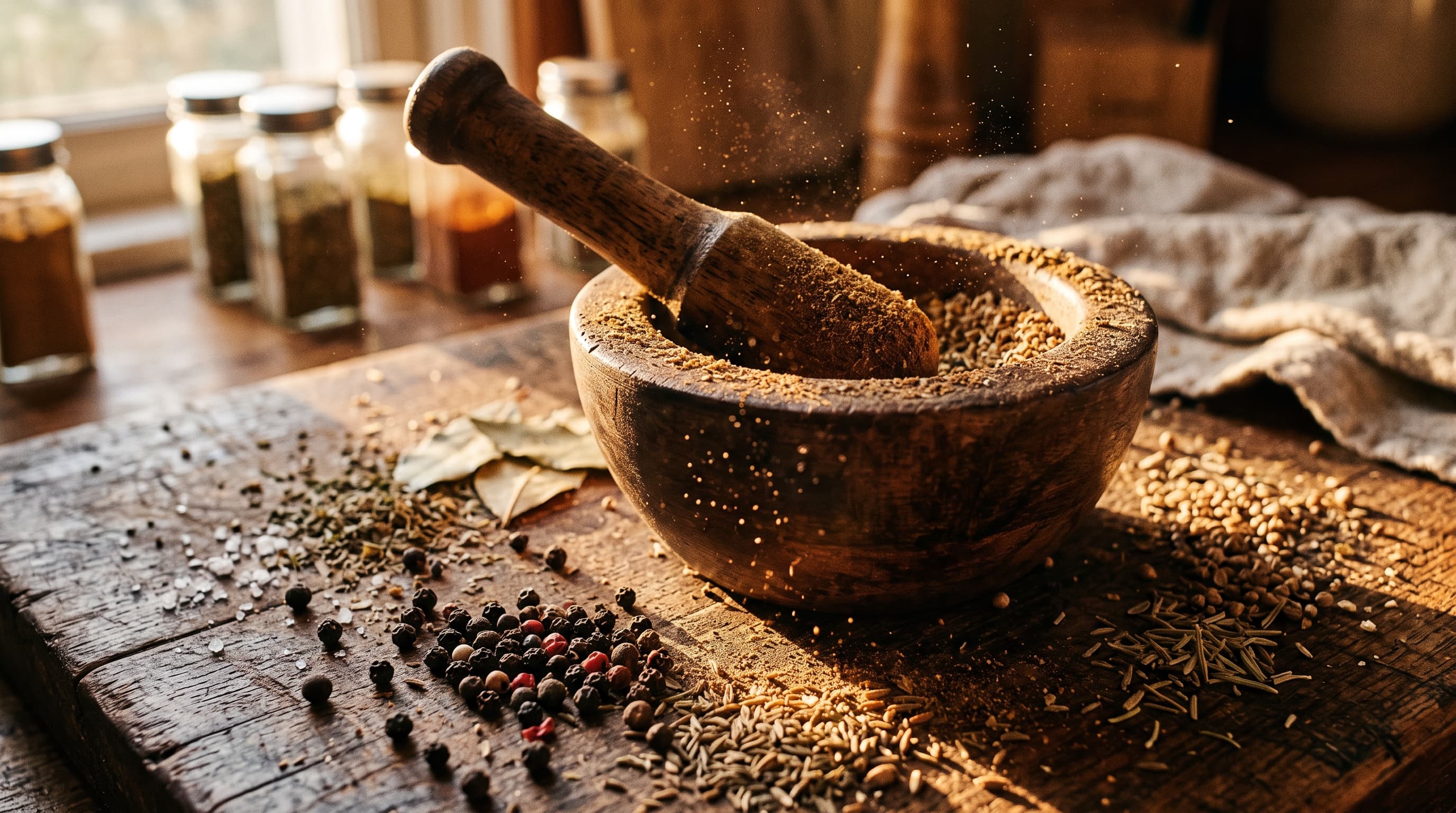
Dukkah is a dry Egyptian blend of toasted nuts, seeds and spices, pounded to a coarse crumb and eaten by dipping bread into olive oil and then into the dukkah. It is sold in cones of paper in Cairo's spice markets and made at home to family recipes.
**It contains hazelnuts, which is not obvious from the name.**
The name explains the texture. Duqqa comes from the Arabic for to pound, and the defining characteristic is that the mixture is crushed to a state that is neither a powder nor a paste, coarse enough to have texture in the mouth, fine enough to stick to oiled bread. Grind it too far and the nut oils release and it turns into a paste, which is the one thing it must not be.
There is no fixed formula. Sesame, coriander, cumin, salt and pepper are near-universal; beyond that it varies by household and by vendor. A nineteenth-century account mentions marjoram, mint, za'atar and chickpeas; a 1978 report names nigella, millet flour and dried cheese; pine nuts, pumpkin seeds and sunflower seeds are more recent. The simplest market version is nothing but crushed mint, salt and pepper.
Dry-toasting each element separately, as the method does, is not fussiness, nuts, sesame and whole spices all reach their best at different rates.
Les mentions alimentaires sont fournies par les contributeurs à titre indicatif. Elles ne sont pas vérifiées par AFN et dépendent des produits que vous achetez. En cas d’allergie grave, vérifiez vous-même chaque ingrédient. Cuisine, allergies et votre propre jugement