

Nous utilisons des cookies essentiels au fonctionnement du site. Nous aimerions aussi déposer des cookies de mesure d’audience et des cookies publicitaires, uniquement avec votre accord. Vous pouvez choisir séparément pour chacun. Lire notre politique relative aux cookies
Loading
Recettes
Parcourez les archives par pays, par plat et par temps de cuisson.
Kachumbari is East Africa's most versatile fresh condiment, a bright, simple salsa of finely diced tomatoes, red onion, chilli, and fresh coriander dressed with lemon juice and salt. It is served at virtually every East African meal as a fresh counterpoint to richer main dishes, and its role in the cuisine is to bring lightness and acidity where everything else is heavy and cooked. The salsa is found across Kenya, Tanzania, Uganda, and Rwanda under the same name, with minor regional variations in chilli heat and whether coriander or mint is used. In Kenya, Kachumbari appears alongside nyama choma (grilled meat), Ugali, fish dishes, and fried snacks. Its simplicity is its strength, perfectly ripe tomatoes and sharp onion need nothing more.
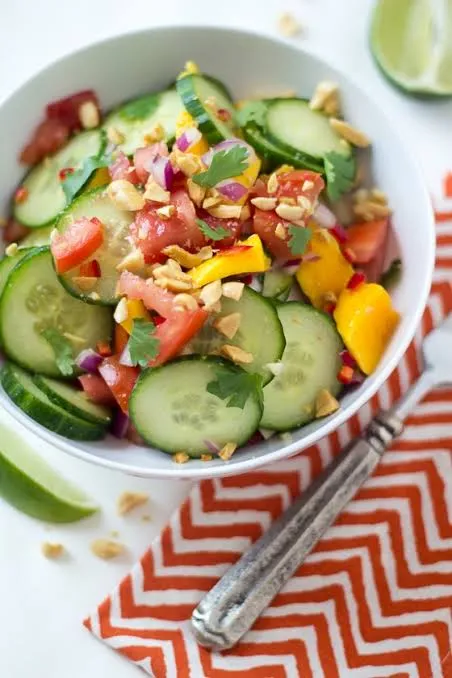
This is an East African salad of mango, cucumber and tomato with chilli, cumin and a little cinnamon, dressed with lime and finished with roasted peanuts. It is served on its own or alongside grilled meat, and its appeal is the contrast: crunchy against soft, sweet against tart.
Mangoes are not indigenous to Africa. They reached the East African coast through Persian traders around the tenth century, part of the same Indian Ocean exchange that brought rice, spices and coconut into Swahili cooking, and they have been grown and eaten there ever since. Kenya and Tanzania are now substantial producers.
The seasoning is what places it. Cumin with a dash of cinnamon in a fruit salad is a Swahili coast combination rather than a Western one, reflecting the same trade history, and the peanuts and lime give it the texture and acidity that hold the whole thing together. Salting the cucumber and onion first and letting them drain for twenty minutes is the technique that matters most: cucumber holds a great deal of water, and skipping it leaves a salad sitting in liquid within minutes of being dressed.
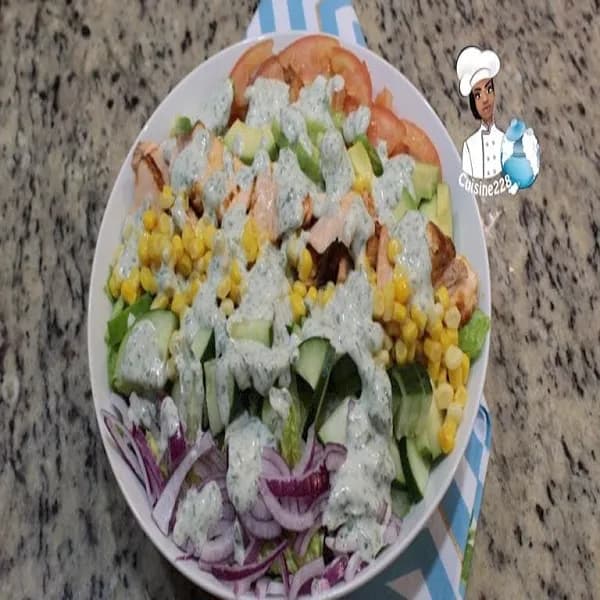
Pan-seared salmon over romaine, cucumber, tomato, red onion and avocado, dressed with an olive oil, mayonnaise and vinegar dressing. The source names no country and the combination is a broadly Western one, so it sits in Worldwide Recipes with its URL unchanged.
Salmon is the reason. It is a cold-water fish of the North Atlantic and North Pacific and is not native to African waters, so while it is imported and eaten in African cities, it belongs to no African tradition. The dishes Africa builds on its own fish are quite different: Senegalese thieboudienne with thiof, Ghanaian grilled tilapia with banku, Libyan haraimi, Egyptian sayadeya.
The technique worth taking from it is the sear. The salmon goes into a warm pan skin side up and is left alone for about four minutes until one side is golden, then turned for another three. Moving it early is what tears the flesh and stops it colouring. The avocado goes in raw at the end and should be added just before serving, since it browns quickly once cut. The dressing is blended separately and drizzled over rather than tossed through, which keeps the leaves crisp.
Vegetables tossed in oil and smoked paprika and cooked low and slow in a barbecue smoker for one to two hours. Like smoked shrimp, this belongs to American barbecue rather than to any African tradition, and no country is named in the source.
Which vegetables work is the useful part. Dense, firm vegetables hold up to the long, low process: potatoes, carrots, beets, brussels sprouts, cauliflower, onions, mushrooms, aubergine and winter squash such as butternut. Softer ones collapse before they take on any smoke. The recipe here uses courgette, yellow squash, onion, bell peppers, asparagus and carrots, which is at the softer end of that range and accordingly needs the shorter end of the time.
Smoked paprika in the seasoning is doing something worth noticing: it brings smoke flavour independently of the smoker, which means the dish reads smoky even before the wood does its work. That is a useful trick in itself, and it means a version of this can be made in an oven with no smoker at all. Africa's charred vegetable traditions are different things entirely, Moroccan zaalouk, Egyptian baba ganoush, West African roasted pepper bases, where vegetables are blackened directly over flame rather than smoked slowly.