Nous utilisons des cookies essentiels au fonctionnement du site. Nous aimerions aussi déposer des cookies de mesure d’audience et des cookies publicitaires, uniquement avec votre accord. Vous pouvez choisir séparément pour chacun. Lire notre politique relative aux cookies
Loading
Recettes
Parcourez les archives par pays, par plat et par temps de cuisson.
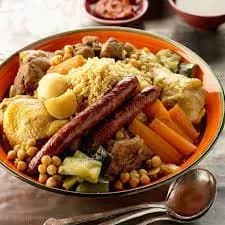
Couscous royale is a plate of fluffy couscous piled with grilled meats and a saffron-scented chickpea and vegetable stew, and it is celebration food. Meatball skewers, lamb chops, chicken skewers and merguez sausage all appear on the same plate, which is what the royale in the name is describing.
Couscous itself is Amazigh in origin. It is a staple across Tunisia, Algeria, Morocco and Libya, and it is Tunisia's official national dish. The food historian Charles Perry places its origin among the Berbers of Algeria and Morocco somewhere between the end of the 11th-century Zirid dynasty and the rise of the 13th-century Almohad Caliphate. The precise origin is not known, and since couscous is made from ground wheat it is unlikely to predate about 6000 BC.
The word names both the semolina grain and the dish built around it. Traditionally the grain is steamed in a couscoussier, a two-tier pot with a steamer sitting above the broth, and it is removed, rolled between the hands to separate the grains, and returned to the steamer four or five times. Pre-steamed couscous has made that unnecessary for everyday cooking. Couscous royale is not everyday cooking: it takes roughly two hours of preparation before the chickpeas are even accounted for.
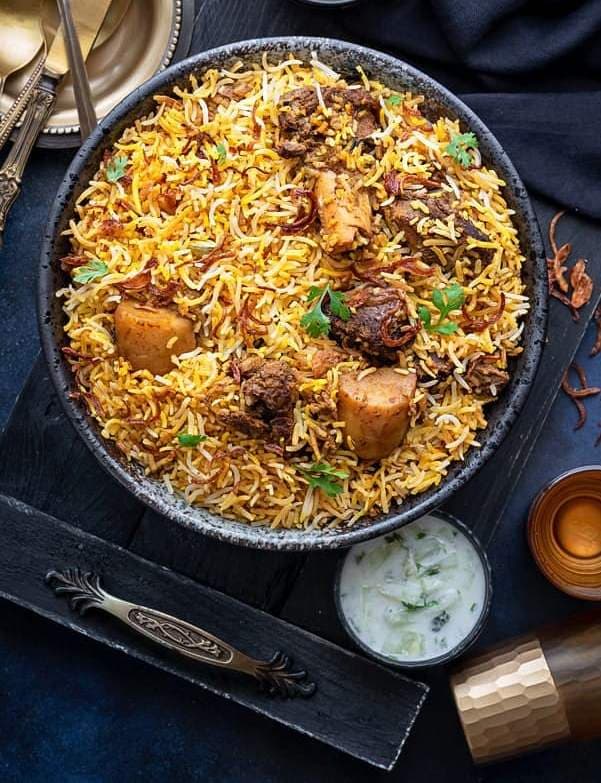
Biryani is a layered rice dish of Persian and South Asian origin that has been part of South African cooking for well over a century, and the South African versions are now traditions in their own right.
The name traces to Persian, birinj biriyan, fried rice, and the dish as it is recognised today developed among Muslim communities in the Indian subcontinent. It reached South Africa with indentured labourers brought to Natal from India from the 1860s, and separately through the Cape Malay community, whose roots lie in the people brought from the Indonesian archipelago and South Asia under Dutch colonial rule.
What emerged is distinct. Durban biryani, the best known, is typically cooked with lentils and potatoes layered through the rice, and it is spiced with the chilli-forward masalas that also produced bunny chow. Cape Malay versions run sweeter, using cinnamon, cardamom and sometimes raisins, reflecting a different spice tradition entirely.
The method is what makes it biryani rather than a spiced rice. Meat and rice are partly cooked separately, then layered and finished together under a sealed lid so the steam carries the spice up through the grains, dum, in the South Asian term.
It is celebration food in South Africa as much as in South Asia: Eid, weddings, and large family gatherings.
Pilau is the spiced rice of the East African coast: rice cooked with cumin, cardamom, cloves, cinnamon and turmeric until every grain carries the spice. It is celebration food across Kenya, Tanzania, Uganda and Zanzibar, made for weddings, for Eid, and whenever a guest of consequence arrives.
It reached the Swahili coast through centuries of Indian Ocean trade, and the family it belongs to runs from Persian polow through Central Asian plov to South Asian pulao. The East African version is milder than the Indian one and does not use curry, which is the distinction the source draws and it is a fair one. The defining spice mix has its own name, pilau masala, and there is a recipe for it on this site.
An important note about this page. Its written description is of a full pilau: caramelised beef, potatoes, tomatoes and pilau masala simmered in meat stock. The recipe card attached to it is something else entirely, a plain spiced rice with no meat, no potatoes and no stock. The recipe below follows the card, since that is the actual recipe on the page, and the result is a good vegetarian side dish. It is not, however, the celebratory beef pilau the description promises.
Browning the onions properly is the step that matters most in either version.
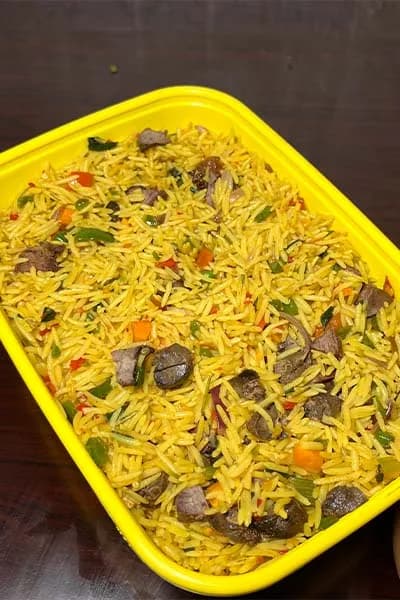
Ghanaian Fried Rice is a bold, protein-packed celebration of leftovers and technique, long-grain rice stir-fried at high heat with diced ham, chicken liver, scrambled eggs, mixed vegetables, and a generous seasoning of soy sauce, curry powder, and mixed spice. It is a fixture of Ghanaian party food and restaurant menus, where it appears alongside jollof rice as the second essential rice option. What distinguishes Ghanaian Fried Rice from Chinese-style fried rice is the spice profile, the curry powder and mixed spice give it a warmth that is distinctly West African, and the inclusion of liver, which adds a deep, iron-rich flavour that is not typical of Asian versions. Day-old cold rice is essential for achieving properly separate, non-mushy grains.