Nous utilisons des cookies essentiels au fonctionnement du site. Nous aimerions aussi déposer des cookies de mesure d’audience et des cookies publicitaires, uniquement avec votre accord. Vous pouvez choisir séparément pour chacun. Lire notre politique relative aux cookies

Loading
Recettes
Parcourez les archives par pays, par plat et par temps de cuisson.
Bamia is a stew of lamb, okra and tomato, and the name is simply the Arabic word for okra, which tells you where the emphasis lies.
It is eaten across an enormous area: all the Arab countries, Anatolia and Turkey, Greece, Afghanistan and Iran, with regional variations at every point. In Egypt it is a household staple and particularly associated with Ramadan, where it appears regularly on iftar tables.
The construction is straightforward. Lamb is browned and stewed with onion, garlic and tomato, seasoned with coriander and cardamom, and okra is added to cook in the sauce. It is often finished in the oven in a clay dish, which is worth doing if you have one, the even, enclosed heat suits it.
The okra question dominates how people feel about the dish. Okra releases a mucilaginous liquid when cut and cooked in liquid, which thickens the stew. Some cuisines prize this; others go to considerable lengths to avoid it. Using whole small okra rather than sliced, and not overworking it, keeps it to a minimum.
Small young pods are much better than large ones, which turn woody.
Oyster mushrooms grilled and tossed in suya spice. It is a plant-based version of the Nigerian street food, and it works better than most meat substitutions do.
**The traditional suya spice contains ground peanuts, and this recipe includes them.** The source flags it and offers to leave them out, which is honest, but it is worth stating clearly, because a peanut allergy and a suya spice blend are a genuinely dangerous combination and the name gives no warning.
Suya proper is skewered beef, ram or chicken rubbed in yaji, the spice blend of ground roasted peanuts, ginger, cayenne, garlic, onion powder and paprika, and grilled over open coals. It is Hausa in origin, from northern Nigeria, and it is sold across Nigeria, Cameroon, Niger, Ghana and parts of Sudan. Kyinkyinga is the Ghanaian name, agashe the Sudanese.
Oyster mushrooms are the right substitution and not an arbitrary one. Shredded, they have a fibrous, layered structure that genuinely resembles pulled meat, they take on the dry rub readily, and they char well. Most vegetables do neither.
The source's method is very compressed, one step reads "put in a preheated medium", with the word oven missing, and has been filled out below.
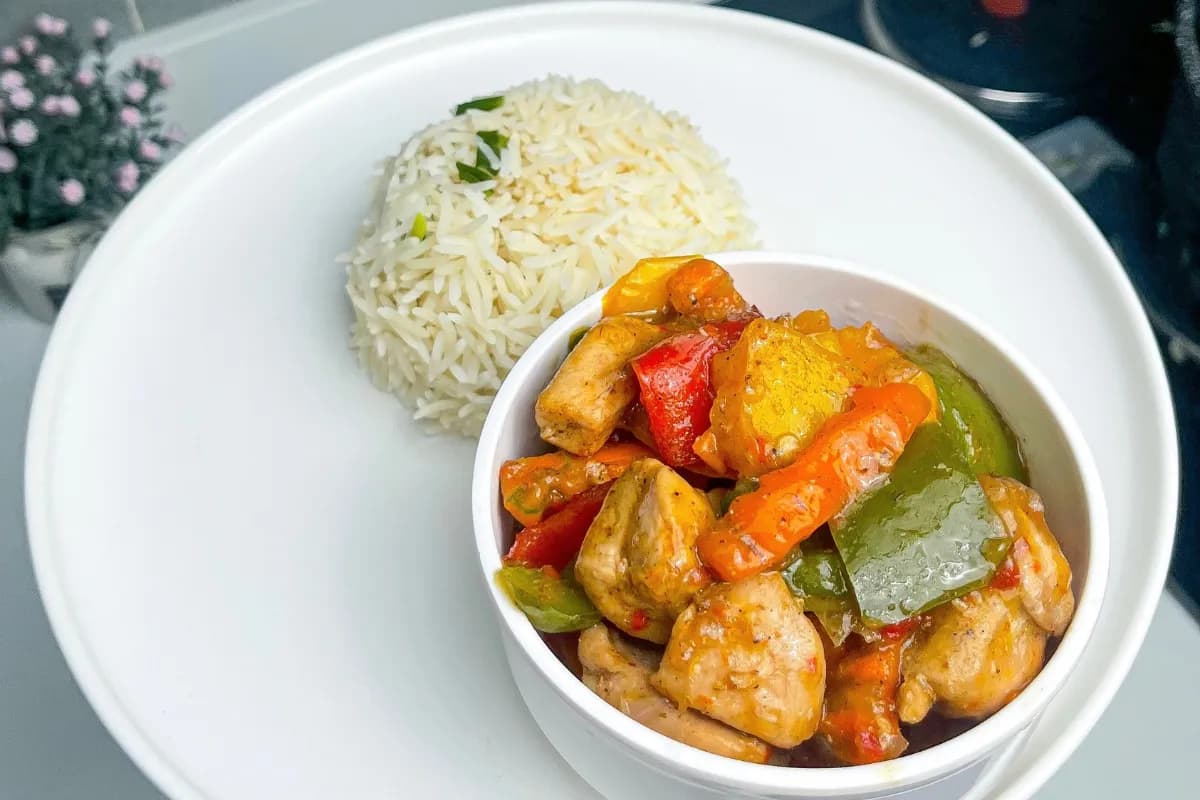
This is a Nigerian take on a curry sauce: chicken breast marinated in ginger, garlic and all purpose seasoning, cooked with carrots and bell peppers, and thickened with a cornstarch slurry rather than reduced or enriched with cream.
Two things mark it as Nigerian rather than South Asian. The first is yaji, the suya spice built on ground peanuts, paprika, cayenne, ginger and garlic, which goes in alongside the curry powder and gives an aromatic depth no Indian curry would have. The second is the cornstarch slurry, which is how a great many Nigerian sauces are thickened, giving a glossy sauce that clings rather than a reduced one.
The vegetables are meant to keep their bite. Carrots and bell peppers go in after the onion and are cooked only until slightly tender, which is characteristic of Nigerian party cooking, where texture and colour matter as much as flavour. The heat is moderate and adjustable through the scotch bonnet. Because yaji contains ground peanuts, this dish carries a peanut allergen despite nothing in its name suggesting one.
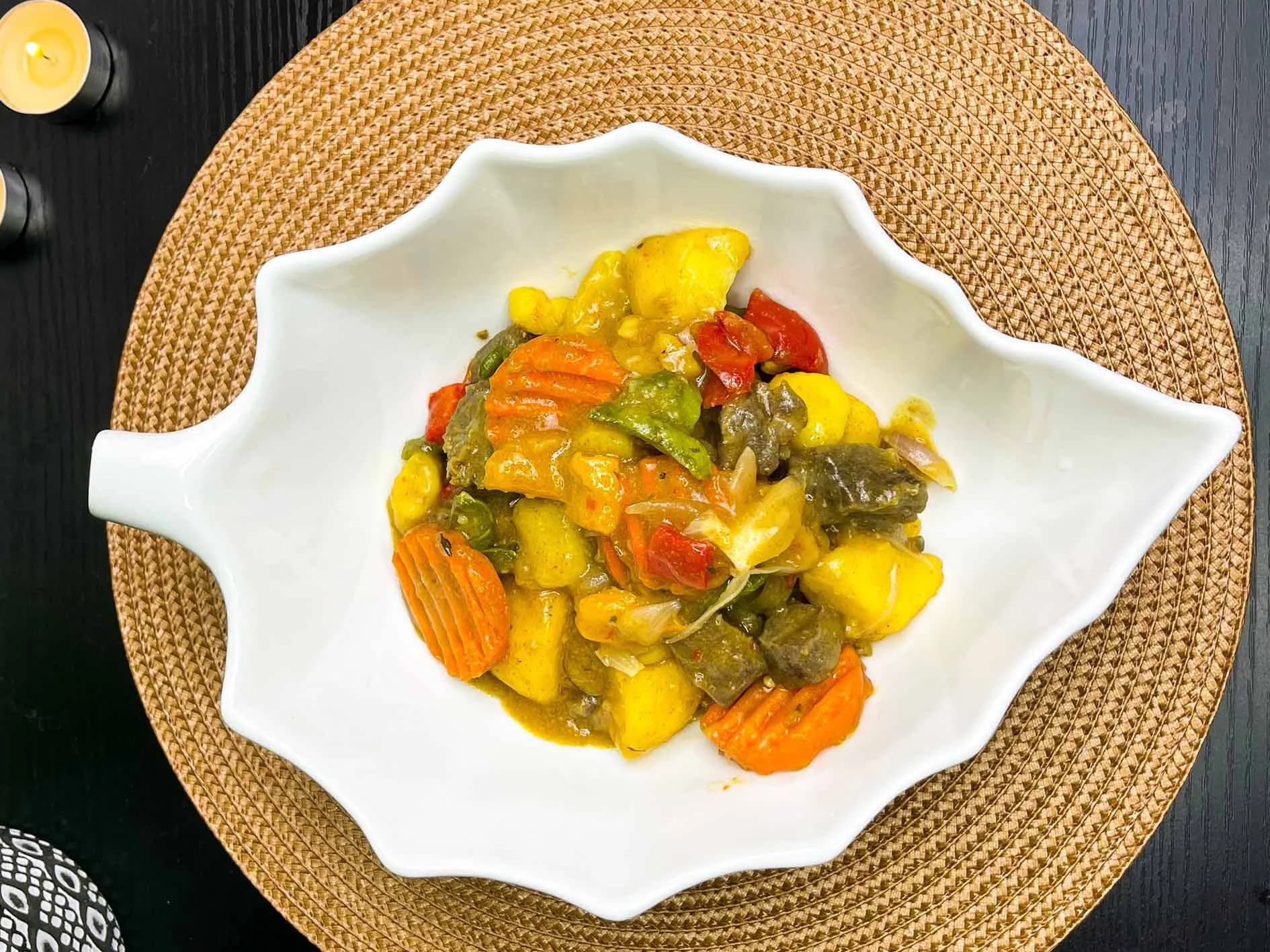
This is beef and potatoes cooked down in a seasoned sauce thickened with cornstarch, and the source names no country. Several details place it in a West African kitchen: seasoning powder, scotch bonnet, curry powder and the term Irish potatoes, which is the Nigerian and Ghanaian way of distinguishing the ordinary white potato from sweet potato and yam.
Coconut milk is offered as one of three options for the cooking liquid, alongside beef broth and plain water, and that choice changes the dish considerably. With coconut milk it reads closer to a Kenyan or Tanzanian coastal stew; with beef broth it is a straightforward brown stew. The source calls the result a curry sauce in one place, which reflects the curry powder rather than any Indian technique.
Sauce here means what it means across West Africa: something spooned over a starch rather than eaten as a soup. It is served with steamed rice or naan, or eaten on its own. The one thing worth adjusting is the timing. Ten minutes of cooking will not tenderise beef cut into bite sized pieces, and a proper braise of forty-five minutes or more is what this needs.