Nous utilisons des cookies essentiels au fonctionnement du site. Nous aimerions aussi déposer des cookies de mesure d’audience et des cookies publicitaires, uniquement avec votre accord. Vous pouvez choisir séparément pour chacun. Lire notre politique relative aux cookies

Loading
Recettes Tunisia
De Kafteji à Tunisian Couscous, de Usban à Ojja (Shakshuka). Toute la cuisine Tunisia, telle qu'on la prépare chez soi.
Tunisian sabayon is a frozen custard of whipped egg, sugar and oil, scented with orange blossom water and served very cold under crushed pistachios or almonds. It resembles its Italian namesake in ingredients and method, with one substitution that changes it entirely: oil replaces the alcohol.
Sabayon comes from the Italian zabaione, and the word appears in French as sabaillon in 1803, apparently brought back by soldiers from the Italian and Swiss expedition of 1799 to 1800. Older origins are claimed, an introduction to the French court in 1533, or an invention in Turin, but these are unverified and some are frankly legendary. The Tunisian version is much more recent than any of them, arriving through Italian influence in Tunisia.
There is one thing to be clear about. Italian zabaione is cooked, whisked over a bain-marie until the eggs thicken. **This version is not cooked at any point.** The eggs are whipped raw, folded together and frozen. That makes it a raw egg dessert, which matters for anyone pregnant, elderly, very young or immunocompromised, and pasteurised eggs are the sensible answer if you are serving it to any of them. It needs at least eight hours in the freezer, so it has to be made the day before.
Loubia is white bean stew, and it is eaten across North Africa: Tunisia, Morocco, Algeria and Libya. Dried white beans are cooked slowly in a tomato sauce heavy with ras el hanout, paprika and turmeric, and the result is a robust, spicy stew scooped up with bread.
It works as a main course or a side, and in Morocco it is a particularly common accompaniment to fried fish. Everyone has their own touch: some cook it with olives, some finish it with parsley or coriander, and chicken, beef or lamb all appear in it. This version uses chicken, cooked in the pot and lifted out while the beans finish, then returned to warm through.
Two practical points the source is clear about. The beans are dried and need overnight soaking, so it has to be planned a day ahead. And the cooking time given assumes a pressure cooker, which the source describes as essential equipment in Moroccan kitchens; without one, allow roughly double. The seasoning should be generous, since a timid hand produces a thin sauce rather than the robust one the dish is known for.
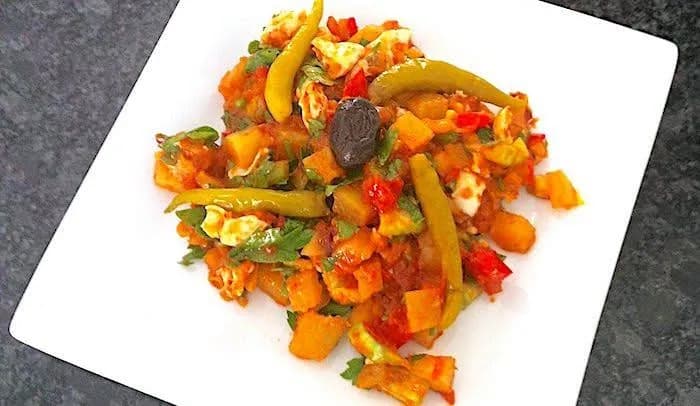
Kafteji is Tunisian street food built on a single idea: fry a range of vegetables separately so each one is properly cooked, then chop them together and serve the result with bread. Potato, courgette, pepper, tomato and aubergine are the usual cast, and the chopping at the end is what makes it kafteji rather than a plate of fried vegetables.
It is sold from small counters and casse-croûte shops across Tunisia and eaten at any hour, most often stuffed into bread as a sandwich. It is inexpensive, which is part of its identity: kafteji is what you eat when you want something substantial and hot without a restaurant. Fried egg is a common addition, and in many Tunisian versions it is the only protein.
The version here includes ground beef or lamb, which puts it at one end of a range. Kafteji is frequently made entirely without meat, and the vegetable only preparation is at least as common in Tunisia as the meat version. Harissa, olives and a squeeze of lemon are the usual finishing touches, and the dish is eaten from a shared plate with bread as the utensil.
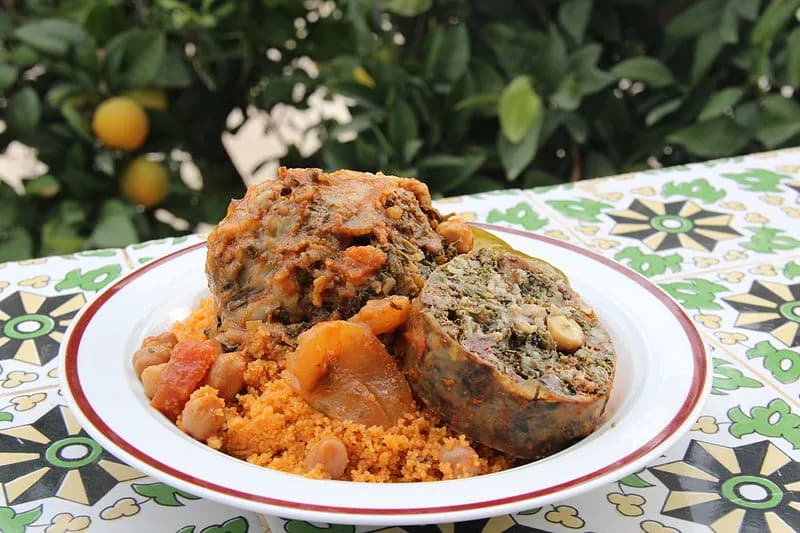
Couscous is the national dish of Tunisia, and it is also the national dish of Algeria, Morocco, Mauritania and Libya, which tells you something about how the Maghreb understands itself. The same steamed semolina appears across all five countries under names that shift with the language: kousksi in Tunisia, taam or kesksu in Algeria, seksu in Morocco, and cuscusu in Sicily, where it crossed the water.
The Tunisian version is distinguished by its heat and its colour. Harissa goes into the broth rather than being offered alongside it, and the finished couscous runs orange to deep red depending on how much broth and harissa it has taken up. Caraway is the other Tunisian signature, appearing in a quantity that Moroccan and Algerian couscous would not use.
What goes with it depends on the coast. In Sfax and the other coastal cities, couscous is made with fish. Inland it more often carries lamb, sometimes with dried fruit. Turnip, carrot, courgette, potato, pumpkin and chickpeas are the usual vegetables, cooked in the broth and removed as each becomes ready. The word itself is traced either to the Arabic kaskasa, to pound small, or the Amazigh seksu, meaning rounded or well rolled, and both derivations describe the grain rather than the dish.