Nous utilisons des cookies essentiels au fonctionnement du site. Nous aimerions aussi déposer des cookies de mesure d’audience et des cookies publicitaires, uniquement avec votre accord. Vous pouvez choisir séparément pour chacun. Lire notre politique relative aux cookies

Loading
Recettes
Parcourez les archives par pays, par plat et par temps de cuisson.
The Nigerian egg roll is a whole hard cooked egg wrapped in a slightly sweet dough and deep fried, and it has nothing to do with the Chinese egg roll beyond the name. The closest comparison is a Scotch egg, with dough in place of sausage meat, and the resemblance ends at the structure.
It is street food and travel food. Egg rolls are sold from glass cases at bus stops, from hawkers' trays in traffic, and from the small kiosks that cluster around Lagos offices, and they exist because they solve a specific problem: something substantial, cheap and self contained that can be eaten with one hand in a stationary car. Anyone who has spent time in Lagos traffic understands the appeal without further explanation.
The dough is what makes it Nigerian rather than generic. Flour, baking powder, sugar, margarine and nutmeg produce something between a bread and a cake, faintly sweet against the plain salted egg inside, and that sweet and savoury combination is a Nigerian snack signature that also runs through buns, puff puff and chin chin. It is eaten with tea, fruit juice or chilled zobo, and it is substantial enough that people eat it as breakfast or lunch rather than as a snack.
Plantain bread is a sweet quick bread built on overripe plantains, and it exists for the same practical reason banana bread does: it is what you make when the fruit has gone too far to eat but is too good to throw out.
The comparison to banana bread is the useful one, and the difference is real. Plantain is starchier and less sugary than banana even when very ripe, so plantain bread comes out slightly denser and less cloying, with a flavour that is deeper and a little more savoury at the edges. People who find banana bread too sweet tend to prefer it.
It uses the plantains at the stage most cooks would consider past it, skins mostly black, flesh soft and heavily speckled. At that point the starches have converted and the fruit mashes easily, which is exactly what the batter needs.
It is a quick bread, chemically raised, so there is no proving and no kneading. Walnuts are a common addition for texture, and it is eaten at breakfast, with tea, or as a snack.
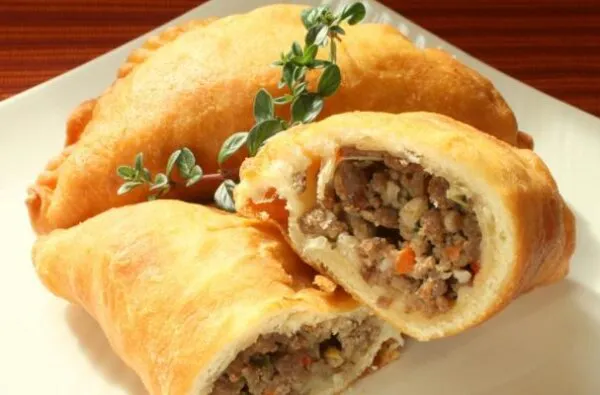
The Nigerian meat pie is a hand pie with a short, slightly flaky crust around minced beef, potato and carrot in a thick gravy. It is not the same thing as a British meat pie or a Jamaican patty, though it is related to both, and Nigerians will tell you the difference immediately: the pastry is denser and less sweet than a patty, and the filling is chunkier and more heavily seasoned than a British one.
It is everywhere. Meat pies are sold from bakeries, from glass warmers in petrol stations, from hawkers at bus stops, and at every party alongside puff puff, chin chin and spring rolls on the small chops platter. They are eaten as breakfast, as brunch, as a snack, and with a soft drink or chilled juice.
The pastry is where it is won or lost. The ratio of fat to flour is treated as a rule rather than a guideline in Nigerian kitchens: half the weight of the flour in margarine, and getting that ratio wrong is the single most common reason a home made meat pie comes out hard. The other is oven heat, which has to be watched rather than trusted, since ovens differ and an overbaked pie is dry.
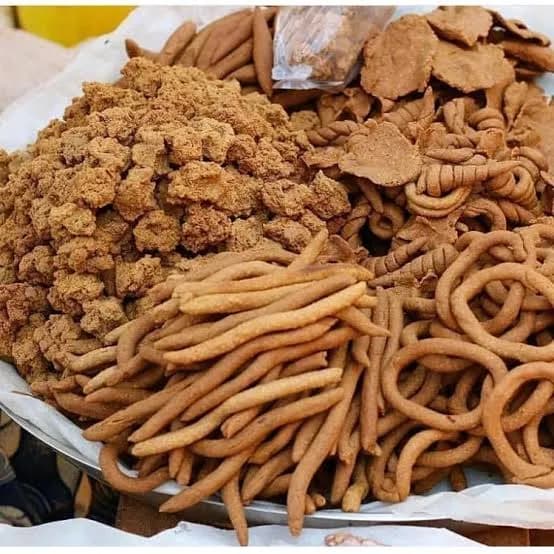
Kuli kuli is a peanut snack eaten across Nigeria, Benin, northern Cameroon and Ghana, and it is one of the most widely recognised street foods in West Africa. It is made from peanuts alone, and the technique is what makes it: the oil is deliberately pressed out of the ground paste before the remaining solids are shaped and fried.
That extraction is the point. Removing the oil leaves a dense, dry paste that fries into something genuinely crunchy rather than soft, and it also produces the frying oil as a by-product, so nothing is wasted. It is a piece of processing knowledge that predates industrial oil pressing and is still done by hand in Hausa communities in northern Nigeria, where the snack has its strongest association.
It takes different shapes in different places: small sticks, rings, flat discs and irregular pieces are all standard, and the form varies by region and by seller. English names for it, groundnut cake and peanut snack among them, are approximations rather than translations. Kuli kuli is eaten on its own, mixed into garri with sugar and water, crumbled over salad, or served alongside fura and koko. Crushed to a powder it becomes the peanut component of suya spice, which is where most people outside the region encounter it without knowing.