Nous utilisons des cookies essentiels au fonctionnement du site. Nous aimerions aussi déposer des cookies de mesure d’audience et des cookies publicitaires, uniquement avec votre accord. Vous pouvez choisir séparément pour chacun. Lire notre politique relative aux cookies

Loading
Recettes
Parcourez les archives par pays, par plat et par temps de cuisson.
Kedjenou is chicken and vegetables sealed in a pot and cooked slowly with almost no added liquid, so the bird cooks in its own juices. It is Ivorian, and the source associates it particularly with the Baoulé.
The method is the entire dish and it is genuinely unusual. Traditionally it is cooked in a canari, an earthenware jar with a narrow opening, which is sealed and set over a wood fire or coals. Because so little liquid goes in and almost none escapes, everything the chicken releases stays in the pot and concentrates. The result is intensely flavoured rather than diluted, the opposite of a stew, where liquid goes in and draws flavour outward.
The name reflects the technique too. Kedjenou is generally understood to refer to shaking, the pot is shaken periodically rather than opened and stirred, because lifting the lid would let the steam out. This recipe reproduces that with foil under a tight lid in a low oven, and it works.
Eggplant, tomato, onion, chilli, ginger and thyme are the standard vegetables. Guinea fowl is as traditional as chicken and arguably more so.
The source's ingredient list gives almost no quantities and splits garlic across two lines. Working amounts are given below.
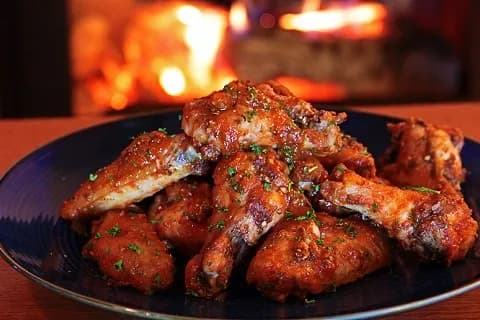
Grilled shito wings are chicken wings grilled and then coated in shito, Ghana's dark chilli sauce, and returned briefly to the heat so the sauce sets onto the skin. It is a modern preparation built on a traditional condiment rather than an inherited dish, and it is none the worse for that.
Shito is the whole point. The word is Ga, the language of Accra, and simply means pepper, though it has come to name the specific dark sauce made from dried fish, ground prawn, chilli, ginger, garlic and tomato cooked down in oil. Its smokiness and depth are what a plain grilled wing lacks, and glazing rather than marinating with it keeps that character intact.
The order matters. The wings are seasoned and marinated plainly first, with salt, oil, pepper, lime and soy, then grilled through, and only then coated in shito and given a short final spell at reduced heat. Shito applied at the start would burn long before the chicken cooked, since it is already a cooked, oily, sugar-free but solids-heavy sauce. Doing it this way gives a wing that is properly cooked underneath and lacquered on the outside.
Oyster mushrooms grilled and tossed in suya spice. It is a plant-based version of the Nigerian street food, and it works better than most meat substitutions do.
**The traditional suya spice contains ground peanuts, and this recipe includes them.** The source flags it and offers to leave them out, which is honest, but it is worth stating clearly, because a peanut allergy and a suya spice blend are a genuinely dangerous combination and the name gives no warning.
Suya proper is skewered beef, ram or chicken rubbed in yaji, the spice blend of ground roasted peanuts, ginger, cayenne, garlic, onion powder and paprika, and grilled over open coals. It is Hausa in origin, from northern Nigeria, and it is sold across Nigeria, Cameroon, Niger, Ghana and parts of Sudan. Kyinkyinga is the Ghanaian name, agashe the Sudanese.
Oyster mushrooms are the right substitution and not an arbitrary one. Shredded, they have a fibrous, layered structure that genuinely resembles pulled meat, they take on the dry rub readily, and they char well. Most vegetables do neither.
The source's method is very compressed, one step reads "put in a preheated medium", with the word oven missing, and has been filled out below.
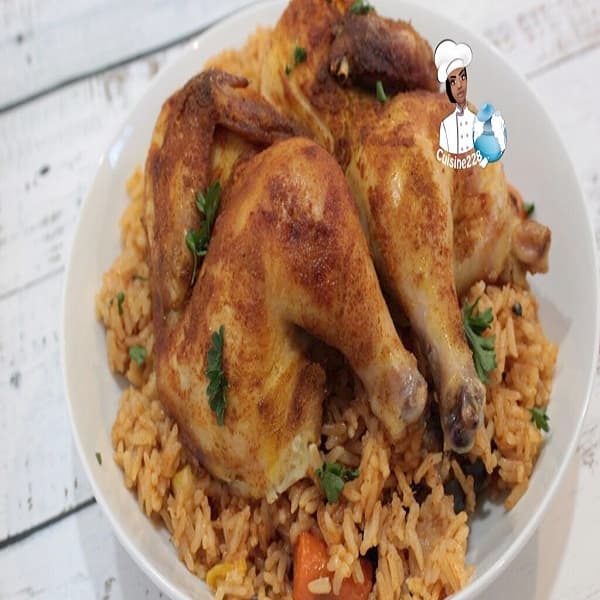
Oven-baked jollof takes the standard West African one-pot and moves it into the oven, where the heat surrounds the dish rather than coming from below.
The reason to bother is practical. Stovetop jollof burns from the base, and getting it right means managing heat carefully, too high and the bottom catches badly, too low and the rice steams unevenly. In an oven the heat is even, the rice cooks through without attention, and the pot cannot scorch in the same way. For anyone who has ruined jollof on a hob, that is a real argument.
What you trade away is the smoky note. That flavour comes precisely from the bottom of the pot catching slightly, and an oven does not give it. Cooks who want both build the base on the hob and finish in the oven.
Everything else is unchanged: the same reduced tomato, red pepper, onion and chilli base, the same long-grain parboiled rice, the same rule about not stirring once it is covered.
It scales well, which makes it useful for cooking for numbers.