Nous utilisons des cookies essentiels au fonctionnement du site. Nous aimerions aussi déposer des cookies de mesure d’audience et des cookies publicitaires, uniquement avec votre accord. Vous pouvez choisir séparément pour chacun. Lire notre politique relative aux cookies

Loading
Recettes
Parcourez les archives par pays, par plat et par temps de cuisson.
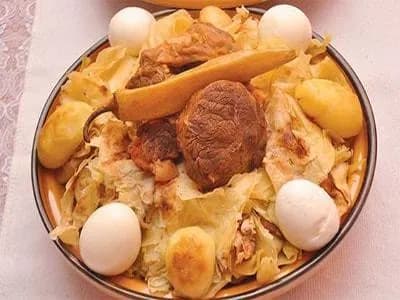
Chekhchoukha, also written chakhchoukha, is torn flatbread under a spiced meat and chickpea sauce, and the name describes the tearing. It comes from tacherchert in the Chaouia language, meaning to crumble or to tear into small pieces, and the bread is broken by hand rather than cut.
It is a Chaoui dish, from the Aurès mountains of eastern Algeria, and it spread from there into Constantine, Biskra and the rest of the country. Its origin is in shepherds' food, the substantial thing eaten on returning home on cold winter nights, and it kept that character even as it became a dish for festive occasions and celebrations rather than everyday eating.
The bread is rougag, also called trid, a very thin round flatbread made from fine semolina. It is torn, steamed briefly to soften, then heaped on a plate and covered with marqa, the sauce of diced lamb, tomato, onion and chickpeas spiced with dried red chilli, caraway, ras el hanout, black pepper and cumin. Two versions are recognised: chakhchoukha of Biskra, which is this one, and chakhchoukha dfar, which uses a different flatbread and differs in taste and thickness. Which pot it is made in also varies, with some cities using clay and others iron.
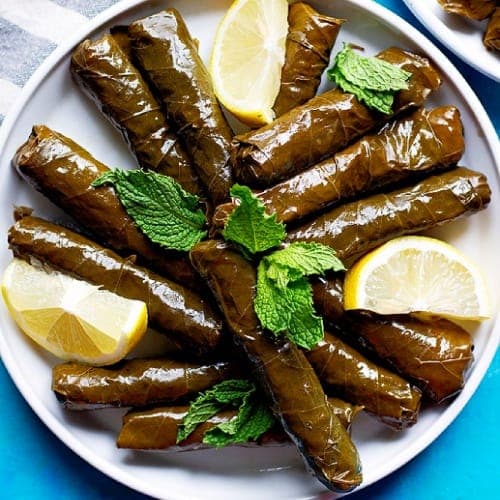
Dolma, known in Egypt as Warak Enab (grape vine paper), are tender grape leaves stuffed with a fragrant mixture of spiced rice, fresh herbs, and sometimes minced meat, then tightly rolled and arranged in a pot to cook slowly in a bright, lemony broth until the filling is perfectly cooked and the leaves are silky and tender. The preparation of Dolma is a communal activity in Egyptian and Levantine households, with family members gathering around a table to roll hundreds of leaves for celebrations. The tightly rolled parcels, no larger than a finger, are arranged in concentric circles in the pot and weight down with a plate to prevent them unravelling during cooking. The result is a dish of impressive elegance built from simple ingredients.
Ka'ak is a ring-shaped bread, crisp outside and soft within, scattered with sesame seeds. It is Libyan in this version, and made across a wide stretch of the Arabic-speaking world, Egypt, Iraq, Iran, Jordan, Lebanon, Palestine and Syria all have their own.
The shape is what defines it. Ka'ak is formed into a large ring, bigger and thinner than a bagel, which is why street vendors across the region can carry stacks of them on a pole or a cart. In Libya it is eaten at breakfast alongside hummus and falafel, and it comes in savoury and sweet versions.
The name travels further than the shape does. Ka'ak, sometimes kahk or kahqa, covers a whole family of baked goods across the Arabic-speaking world, from this ring bread to the small filled Egyptian cookies eaten at Eid, which are a completely different thing. The word means something closer to "baked good" than to any specific item.
One technique in this recipe is worth borrowing for other breads. A tray of water is placed in the bottom of the oven while it heats, so the loaves bake in a steamy environment. Steam keeps the crust soft for the first minutes, letting the bread rise fully before the surface sets, and then produces a thin, crisp finish.