Nous utilisons des cookies essentiels au fonctionnement du site. Nous aimerions aussi déposer des cookies de mesure d’audience et des cookies publicitaires, uniquement avec votre accord. Vous pouvez choisir séparément pour chacun. Lire notre politique relative aux cookies

Loading
Recettes
Parcourez les archives par pays, par plat et par temps de cuisson.
Doro Wat is Ethiopia's most celebrated dish, a deeply spiced, slow-cooked chicken stew made with the country's signature berbere spice blend and niter kibbeh (Ethiopian spiced clarified butter), enriched with whole boiled eggs that absorb the complex, fiery sauce as they cook. It is the dish that defines Ethiopian cuisine for the world. Preparing Doro Wat properly requires patience. Caramelising a large quantity of onions for up to an hour in niter kibbeh forms the foundation, this long-cooked onion base is what gives the stew its extraordinary depth and the sauce its thick, velvet-like body. The berbere adds heat, complexity, and colour. The result is one of the most flavourful chicken dishes in the world.
Dried white beans cooked until tender, then finished with red onion and sliced tomatoes into a thick, soupy stew. It is Malagasy, and it is served everywhere on the island.
It is laoka, which is the useful word here. In Malagasy eating, rice is the meal and laoka is whatever accompanies it, the thing that goes on top of, or beside, a large plate of rice. Tsaramaso is one of the most popular laoka in the country, and it is eaten as a matter of course rather than as an occasion dish.
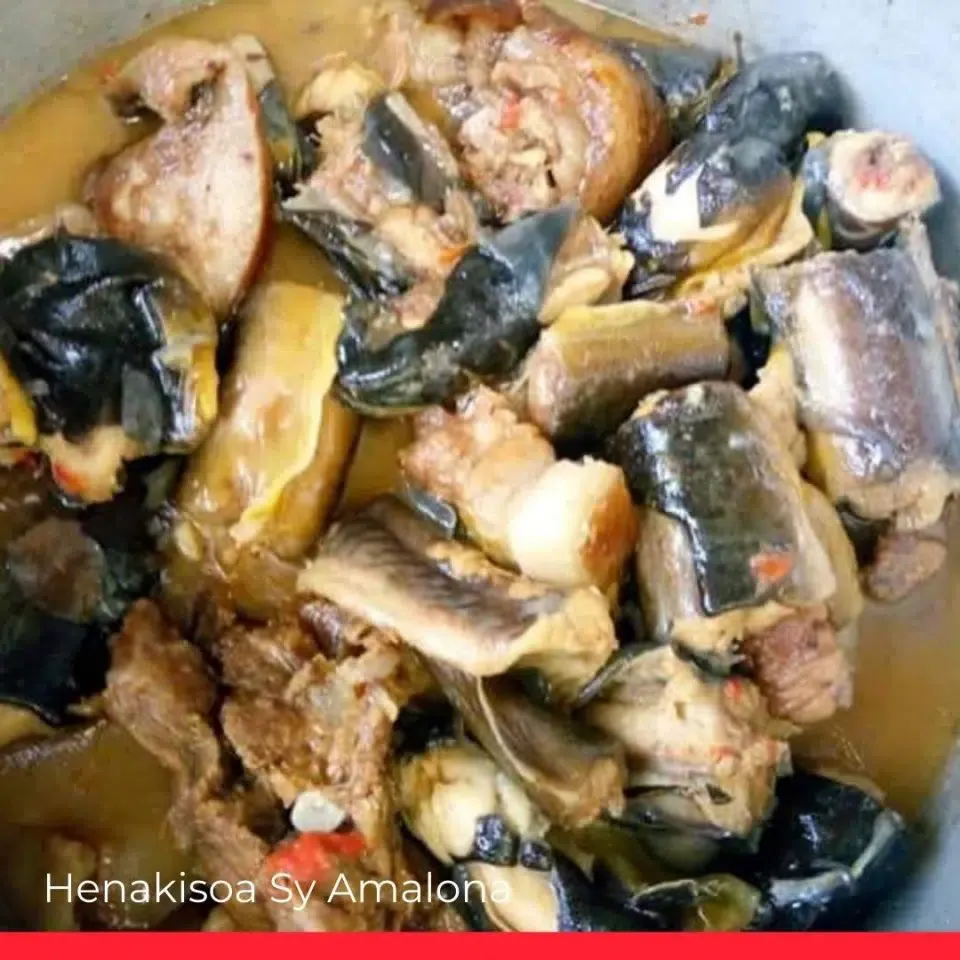
It is very often not vegetarian. Zebu meat, the humped cattle that are central to Malagasy life, makes it hen'omby sy tsaramaso, and pork makes it tsaramaso sy henakisoa. The shank is the cut the source recommends. This version is the plain one, which is also widely eaten.
The technique in the recipe is worth noting: the beans are cooked separately in water, seasoned only at the end, and a cup of their cooking liquid is kept back. That liquid is what the finished stew is loosened with, and it carries starch and flavour that plain water would not.
The source compares it to cassoulet, which is a reasonable shorthand, beans and meat cooked long and slow, though the seasoning is entirely different.
Matoke is green cooking banana, and in Uganda it is close to being the national dish. The word names both the banana variety and the dish made from it, which tells you how central it is.
These are not the bananas eaten raw. They are harvested green, when the flesh is firm and starchy rather than sweet, and they must be cooked. Treated this way they behave much more like a potato than a fruit, they take on the flavour of whatever they are cooked with, and they fill you up in a way that has made them a staple across Uganda, Kenya, Tanzania and Rwanda.
The classic Ugandan preparation steams the peeled bananas, often wrapped in their own leaves, until soft, then mashes them. Served that way it is the base of a meal, eaten with groundnut sauce, beans or meat. It is also known as ebitookye in parts of Uganda and as matoke or mataba more broadly across the region.
The version here is the stewed form rather than the steamed and mashed one, sliced bananas simmered with tomato, chilli and lemon into something closer to a vegetable stew, finished with coriander. Both are matoke, and which one is meant depends entirely on where you are.
Peeling raw green banana stains the hands and the sap is sticky; oiled hands help.
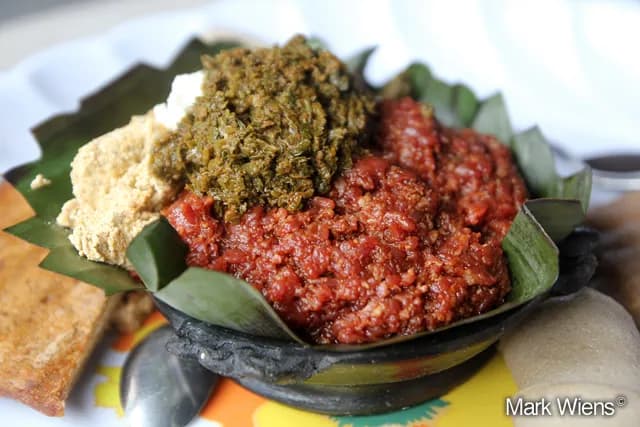
Kitfo is very finely minced raw beef, warmed through with spiced clarified butter and chilli. The name says what it is: kitfo comes from the Amharic for chopping finely. It is Ethiopian and Eritrean, and it is celebration food, a dish for major holidays, weddings and family occasions rather than an ordinary weeknight.
Two things define it. The first is niter kibbeh, the clarified butter infused with garlic, ginger, cardamom, fenugreek and other spices, which is what carries flavour into meat that is never exposed to direct heat. The second is mitmita, the fierce Ethiopian chilli blend built on pili-pili peppers with cardamom, cloves and salt. Both are what separate kitfo from any other steak tartare.
Doneness has its own vocabulary, and the names matter because they are what you order by. Tere kitfo is fully raw. Leb leb is warmed just enough to melt the butter through it. Yebesele is taken further still. Gored gored, which is on this site as its own recipe, is the closely related dish where the beef is cut into cubes rather than minced, same tradition, different knife work, noticeably different in the mouth.
It is served with injera, and usually alongside gomen, the collard greens, and ayib, the fresh Ethiopian cheese, whose mildness is there to answer the heat.
Les mentions alimentaires sont fournies par les contributeurs à titre indicatif. Elles ne sont pas vérifiées par AFN et dépendent des produits que vous achetez. En cas d’allergie grave, vérifiez vous-même chaque ingrédient. Cuisine, allergies et votre propre jugement