Nous utilisons des cookies essentiels au fonctionnement du site. Nous aimerions aussi déposer des cookies de mesure d’audience et des cookies publicitaires, uniquement avec votre accord. Vous pouvez choisir séparément pour chacun. Lire notre politique relative aux cookies

Loading
Recettes Nigeria
De Dambu With Veggies à Alkubus, de Amala Lafun and Ewedu Soup à Otong Soup. Toute la cuisine Nigeria, telle qu'on la prépare chez soi.
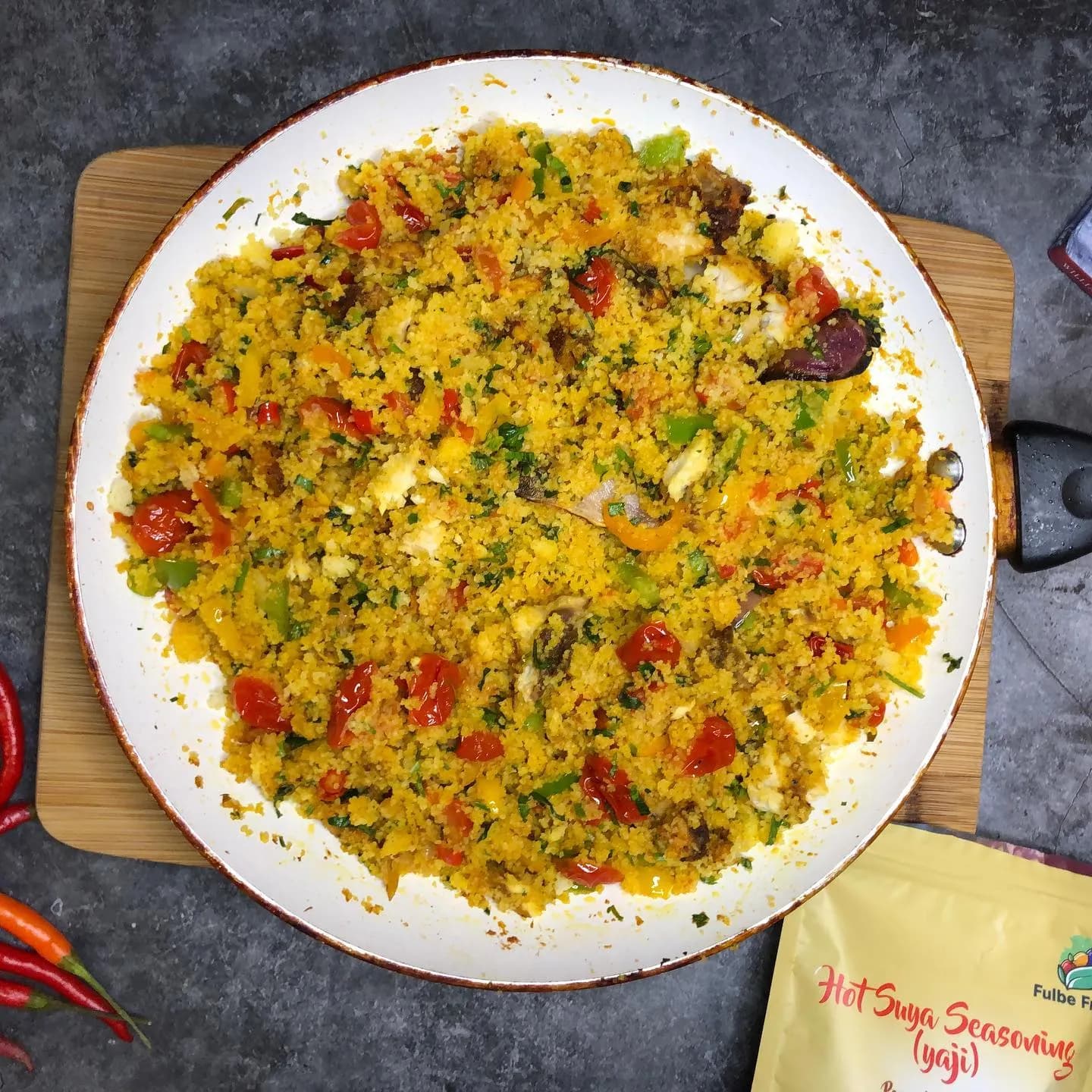
Dambu is a Hausa steamed grain dish made from grits rather than flour, and the distinction is what gives it its texture. Whole maize, wheat, sorghum or millet is cracked into coarse pieces called tsaki, moistened, and steamed until the grains separate into something that looks and eats a great deal like couscous.
Which grain goes in decides which dambu you are making. Tsakin masara is maize grits and tsakin alkama is wheat, and Hausa households treat the versions as distinct in the same way they distinguish between the tuwo made from each grain. The steaming is done in two stages, with the additions going in halfway, which is what lets the groundnuts and vegetables perfume the grain rather than sit on top of it.
In its plain form dambu is eaten with oil and chilli flakes and served alongside a soup such as miyan taushe, miyan kuka or a tomato stew. It can also be built out into a complete dish with meat, vegetables, oil and seasoning worked through it, which is what this version does and which Hausa cooks describe as making it jollof. The word dambu also names a shredded dried meat, dambu nama, which is a different preparation entirely despite the shared name.
Otong soup is the Efik okra soup of Cross River State in south eastern Nigeria, and what separates it from every other okra soup in the country is the pairing of two vegetables rather than one. Okra provides the draw; ikong ubong, the pumpkin leaf known elsewhere as ugwu, provides the body and the green. Uziza leaf goes in for aroma.
Okra soup is made across Nigeria and the names shift with the language: ila asepo among the Yoruba, okwuru among the Igbo, miyan kubewa in Hausa, and otong among the Efik. Each has its own emphasis, and the two vegetable combination is what marks this one as Efik rather than anything else.
The technique is short and the timing is unforgiving. Okra goes in near the end, the pot is never covered after that point, and the soup comes off the heat while the okra is still green and resilient, because the retained heat keeps cooking it for another couple of minutes. Covered or overcooked, okra goes brown and loses its texture entirely. The Efik version is generous with seafood, taking in prawns, crab, mussels and smoked catfish alongside the assorted meat, which reflects a state built around water. It is eaten with ayan ekpang, the grated steamed cocoyam, or with any swallow.
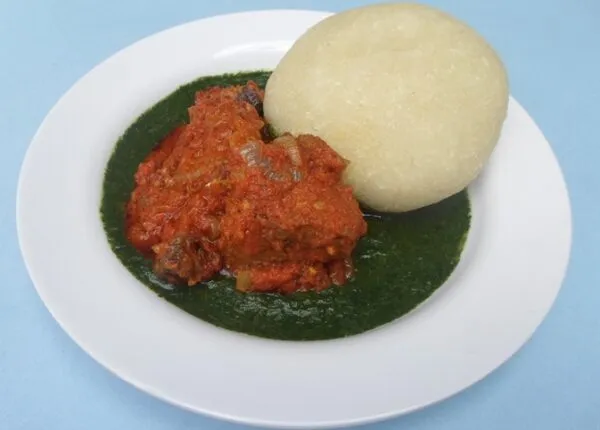
Amala lafun is white amala, made from cassava flour rather than the dried yam flour that produces the dark version, and it is particularly associated with the Oyo people of southwestern Nigeria. Ewedu is jute leaf soup, whisked to a fine green draw. Together they are one of the most eaten combinations in Yorubaland.
The buka is where most people first meet it. Nigerian bukas, the small cheap eating houses of the southwest, serve amala with ewedu and a pepper stew as a matter of course, and the three together are called abula. Ordering it is a single decision rather than three, and people have loyalties to particular bukas that last decades.
Lafun behaves differently from black amala and needs handling to match. Where elubo from yam is added to water taken off the heat, lafun is thickened gradually with hot water and benefits from a brief steam on the stove afterwards, which is what gives it the smooth stretchy texture it should have. Ewedu is cooked with potash, which holds the green colour and helps the leaves break down, and is mashed with an ijabe, the cooking broom, into fine pieces rather than blended smooth. It is also eaten with okra soup and efo riro.
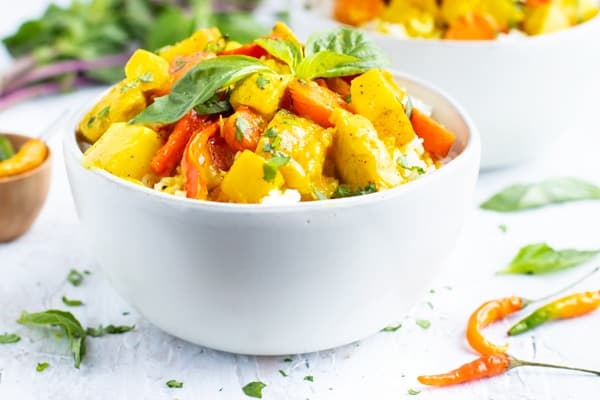
Coconut chicken curry is a one-pan dish of chicken simmered in coconut milk with a curry spice blend and whatever vegetables are to hand, broccoli, cabbage, peppers, potato, carrot.
The word curry is worth being precise about. It is not a single spice or a single dish. It comes from English usage during colonial rule in India, applied broadly to spiced saucy dishes, and it now covers an enormous range of unrelated cooking across South Asia, Southeast Asia, the Caribbean and East Africa. A curry powder sold in a jar is a blend, and the blends differ substantially between manufacturers and regions.
Coconut milk versions belong mainly to the coastal and tropical end of that range, southern India, Thailand, Malaysia, the Caribbean, and the Swahili coast of East Africa, where coconut is grown and used heavily.
This particular recipe is a general one rather than a regional tradition, which is its strength: it tolerates substitution well and is designed to be varied.
**Filed as Worldwide**, the recipe as written makes no specific national claim, so attributing it to any one cuisine would be inventing detail.