Nous utilisons des cookies essentiels au fonctionnement du site. Nous aimerions aussi déposer des cookies de mesure d’audience et des cookies publicitaires, uniquement avec votre accord. Vous pouvez choisir séparément pour chacun. Lire notre politique relative aux cookies

Loading
Recettes Morocco
Parcourez les archives par pays, par plat et par temps de cuisson.
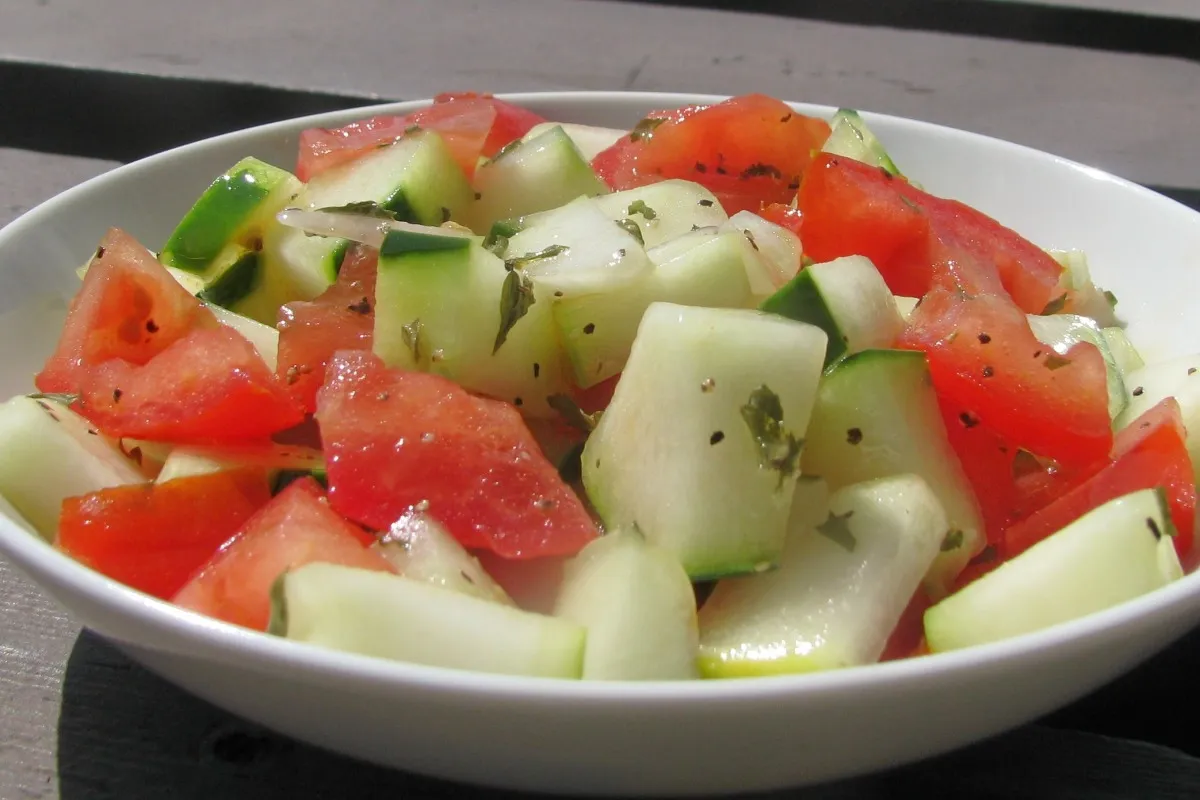
Shlada is the Moroccan tomato and cucumber salad, dressed with lemon and olive oil and seasoned with cumin. It goes by shlada 'arobiya, meaning country salad, and shlada Nationale, the national salad, which tells you how ordinary and how ubiquitous it is.
Everything depends on the knife work. The tomatoes, cucumber and onion are chopped very small, so that a single spoonful carries all three rather than one at a time. The contributor is emphatic that this is the secret of the salad, and it is a fair claim: the same ingredients in rough chunks make a quite different and much less interesting dish.
It also needs to sit. Ten minutes before serving lets the flavours combine, and up to an hour improves it further, which is unusual for a salad. Preserved lemon peel is the optional addition that makes it unmistakably Moroccan, and only the peel is used, never the pulp. It is eaten as a side, as a light lunch, and as a dip scooped up with khobz, the Moroccan bread. Parsley substitutes for mint, vinegar for lemon juice, and vegetable oil for olive oil, all of which are made.
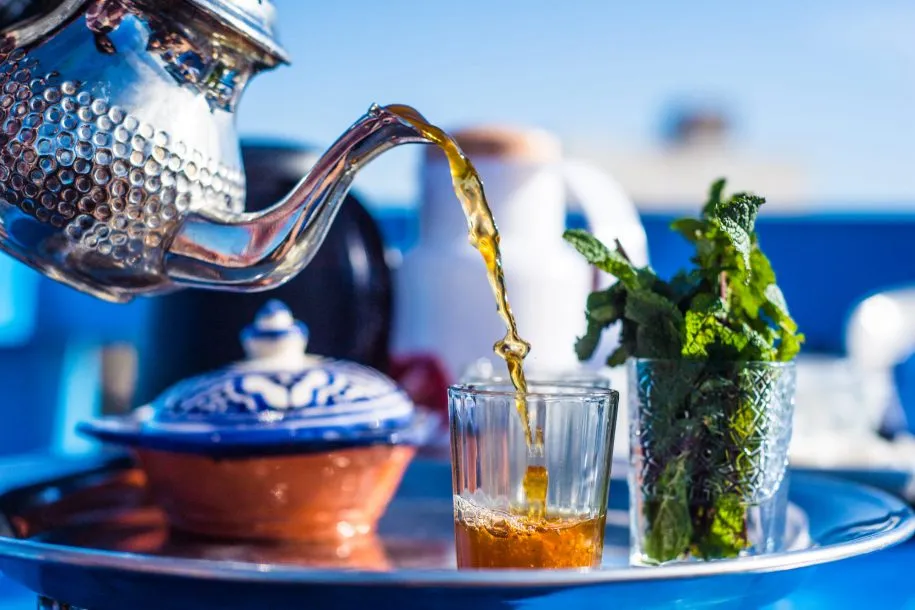
Moroccan mint tea is green tea infused with spearmint and heavily sweetened, and in Morocco it is not simply a drink. It is a sign of hospitality and friendship, served all day, after every meal and through every conversation, and Moroccans take enough pride in it to argue over who among their friends makes the best cup.
Its history is more recent and more accidental than most people expect. Tea reached Morocco in quantity through the Crimean War in the 1850s, when the British East India Company diverted shipments intended for the Baltic states and found itself with a surplus of Chinese tea to sell. Moroccans were the first to infuse it with mint, as a way of countering the bitterness of gunpowder green tea, and the combination stuck.
It is drunk across Morocco, Algeria, Tunisia, Libya and Mauritania, and in parts of the Near and Middle East. It is called shai bi na'na' in classical Arabic and atay or latay in Maghrebi Arabic. The method here involves two rinses of the tea leaves before the tea is made, one of which is kept as the essence and returned to the pot, and one discarded. That step is what removes the harshest bitterness while keeping the strength.
Meskouta is the everyday Moroccan cake, a plain, moist yoghurt cake scented with lemon, made constantly at home and served with mint tea.
Its most charming feature is how it is measured. Many Moroccan households still bake by volume using whatever container is to hand, and meskouta is built around the empty yoghurt pot: one pot of yoghurt, then that same pot used to measure the oil, sugar and flour. No scales, no conversion, nothing to look up. It is why the cake is so often the first thing children are taught to bake, and why the recipe travels between families without ever being written down properly.
The result is a simple, tender cake with a fine crumb, more like a pound cake than anything frosted. Lemon zest is standard, though lime works and is a common substitution.
It is served plain, or with jam alongside to spread on the slice, which is the usual way at teatime. It is not a celebration cake and does not pretend to be, it is what is in the kitchen when someone calls round.
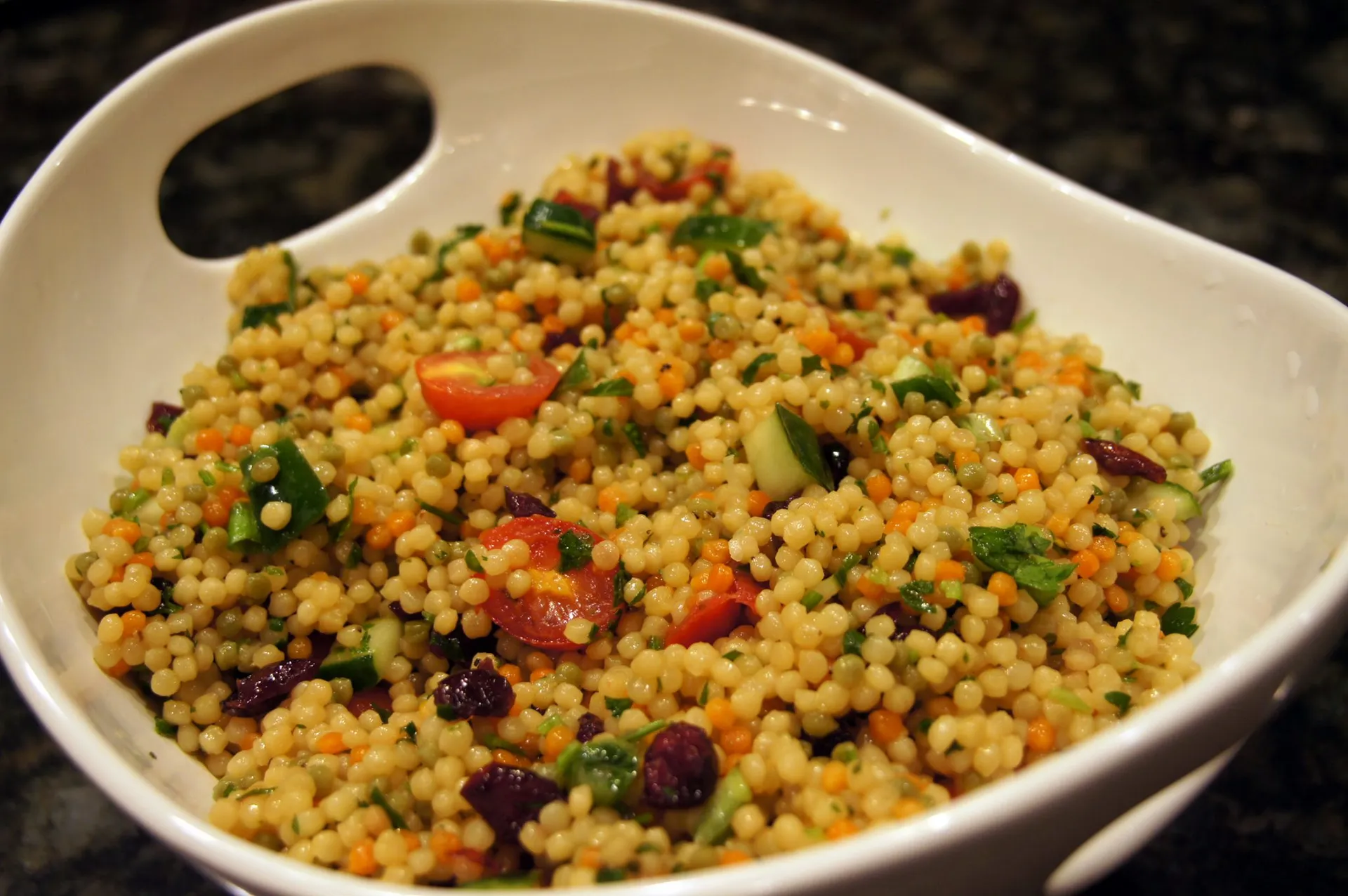
How to prepare instant couscous: boiling water or stock poured over, covered, left to steam, then fluffed. This is a technique page for a staple ingredient rather than a recipe for a dish, and it is filed as such.
Couscous is North African, specifically Berber in origin, and it is a staple across Morocco, Algeria, Tunisia and Libya. Its status was recognised by UNESCO in 2020, when the knowledge and practices around couscous were inscribed on the Representative List of the Intangible Cultural Heritage of Humanity in a joint submission by Algeria, Mauritania, Morocco and Tunisia.
It is not a grain, despite looking like one. Couscous is pasta, durum wheat semolina moistened, rolled into tiny granules and dried. Three sizes are common: Moroccan, the smallest; Israeli or pearl couscous, about the size of peppercorns; and Lebanese, the largest.
The traditional method has nothing to do with pouring boiling water on. Couscous is steamed, usually more than once, in the upper chamber of a couscoussier over a stew whose vapours flavour it as it cooks. That is how it is made for a proper meal in North Africa and the results are much lighter.
Almost all couscous sold in supermarkets is pre-steamed and dried, which is why the rehydration method here works.
Les mentions alimentaires sont fournies par les contributeurs à titre indicatif. Elles ne sont pas vérifiées par AFN et dépendent des produits que vous achetez. En cas d’allergie grave, vérifiez vous-même chaque ingrédient. Cuisine, allergies et votre propre jugement