Nous utilisons des cookies essentiels au fonctionnement du site. Nous aimerions aussi déposer des cookies de mesure d’audience et des cookies publicitaires, uniquement avec votre accord. Vous pouvez choisir séparément pour chacun. Lire notre politique relative aux cookies

Loading
Recettes Morocco
Parcourez les archives par pays, par plat et par temps de cuisson.
Chicken tagine is Moroccan slow cooking at its most recognisable: chicken with preserved lemon, olives, onion and a warm spice blend, cooked gently until the meat falls apart. The name belongs to the vessel as much as the dish.
A tagine is a shallow ceramic or unglazed clay pot with a tall conical lid. The cone is not decorative: steam rises, condenses against the cone and runs back down into the base, so the dish cooks in its own recirculating moisture with very little added liquid. It works like a slow cooker and gives the same result, meat that is tender and a sauce that has concentrated rather than evaporated.
The spice profile is the Moroccan signature: paprika, cumin, ginger, coriander, cinnamon and cayenne together, with honey for balance and lemon for sharpness. Cracked green olives and preserved lemon go in at the end so they keep their character. It can be made in a tagine, in a Dutch oven, or on the stovetop, and this recipe uses the last. If you cook in an actual tagine on a hob, use the lowest setting you can: raising the heat cracks the clay.
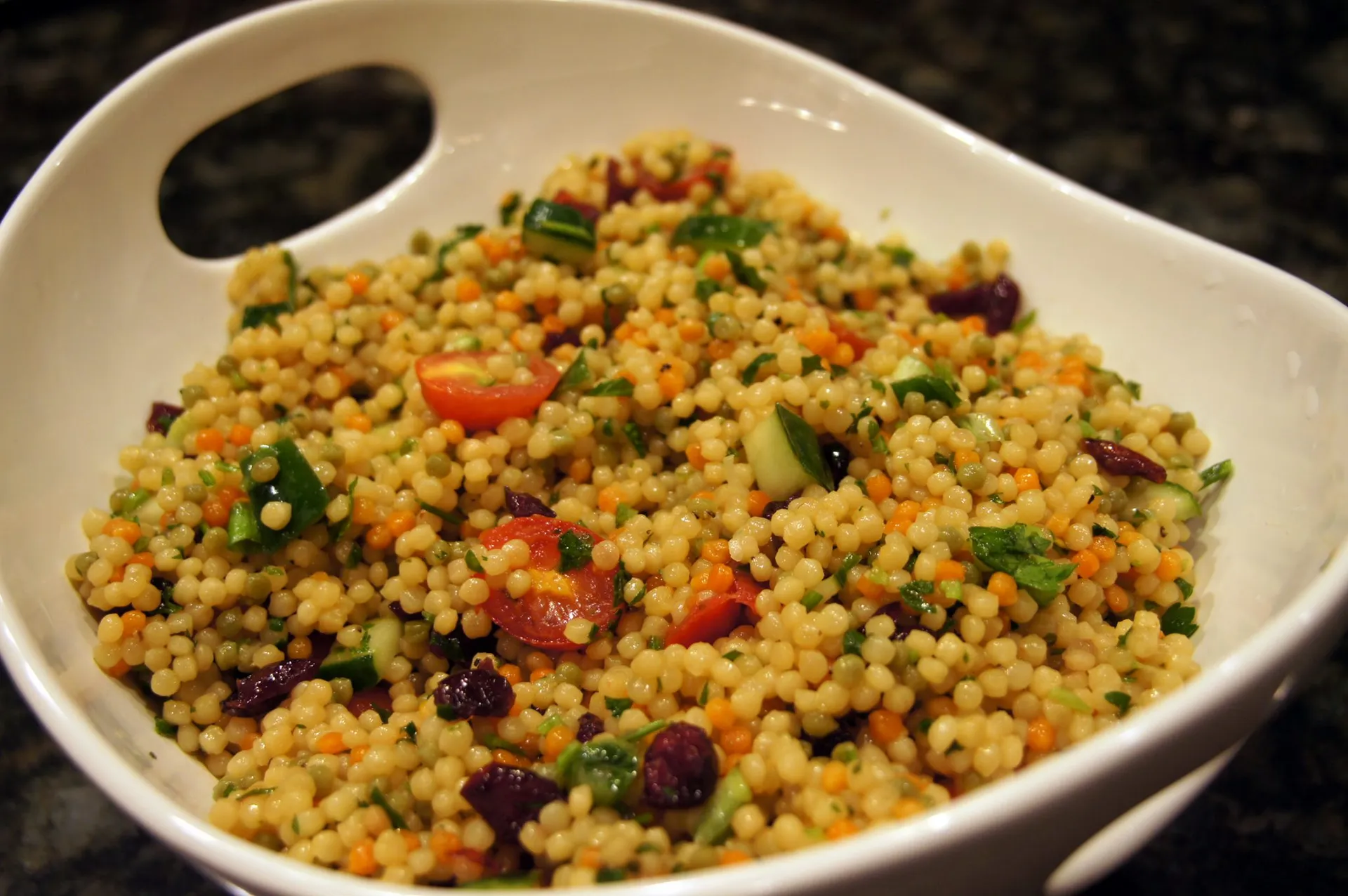
This is couscous with roasted vegetables, chickpeas, raisins and almonds, dressed with lemon, cumin and olive oil. It is a salad in the sense of being served at room temperature rather than a leafy one: the couscous is the bulk of it and the vegetables are folded through.
Couscous was first made by the Amazigh people of North Africa, who worked out how to turn wheat into fine granules, and it remains a staple across Morocco, Algeria, Tunisia and Libya. Moroccan couscous is the smallest of the common grades, finer than Israeli or Lebanese couscous, and it is what this recipe uses.
The technique is absorption rather than steaming. Hot broth is poured over the dry couscous, which has been tossed with olive oil and turmeric, and it is covered and left for five minutes. The raisins go in during that time so the residual heat plumps them. Traditional Moroccan couscous is steamed repeatedly in a couscoussier, which produces a lighter grain; this is the quick domestic method. The vegetables are roasted separately and folded in, which keeps them caramelised rather than steamed into the grain.
How to prepare instant couscous: boiling water or stock poured over, covered, left to steam, then fluffed. This is a technique page for a staple ingredient rather than a recipe for a dish, and it is filed as such.
Couscous is North African, specifically Berber in origin, and it is a staple across Morocco, Algeria, Tunisia and Libya. Its status was recognised by UNESCO in 2020, when the knowledge and practices around couscous were inscribed on the Representative List of the Intangible Cultural Heritage of Humanity in a joint submission by Algeria, Mauritania, Morocco and Tunisia.
It is not a grain, despite looking like one. Couscous is pasta, durum wheat semolina moistened, rolled into tiny granules and dried. Three sizes are common: Moroccan, the smallest; Israeli or pearl couscous, about the size of peppercorns; and Lebanese, the largest.
The traditional method has nothing to do with pouring boiling water on. Couscous is steamed, usually more than once, in the upper chamber of a couscoussier over a stew whose vapours flavour it as it cooks. That is how it is made for a proper meal in North Africa and the results are much lighter.
Almost all couscous sold in supermarkets is pre-steamed and dried, which is why the rehydration method here works.