Nous utilisons des cookies essentiels au fonctionnement du site. Nous aimerions aussi déposer des cookies de mesure d’audience et des cookies publicitaires, uniquement avec votre accord. Vous pouvez choisir séparément pour chacun. Lire notre politique relative aux cookies

Loading
Recettes Liberia
Parcourez les archives par pays, par plat et par temps de cuisson.
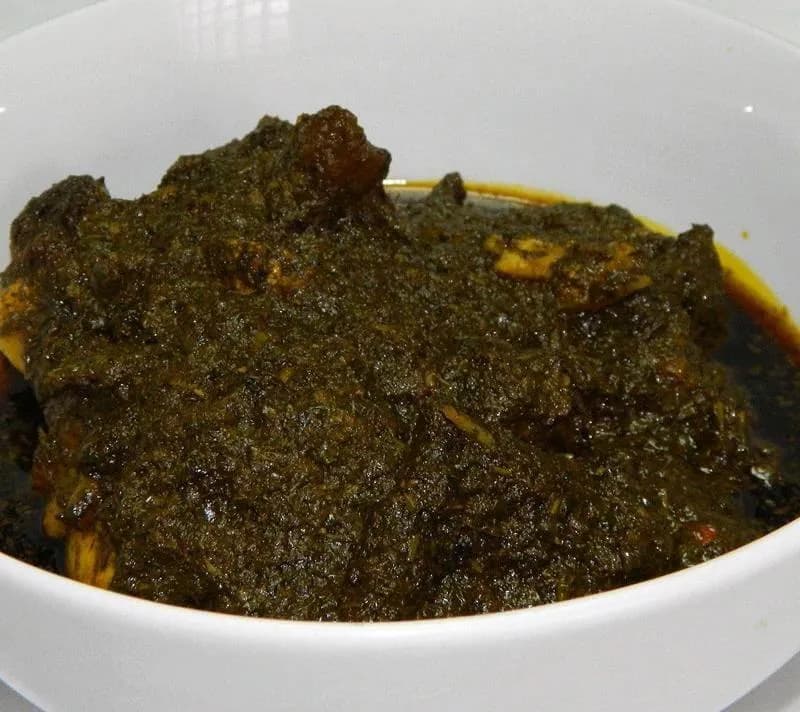
Cassava leaf soup is eaten from Liberia and Sierra Leone through to Central Africa, where it is known as saka saka or pondu, and it is one of the most widely shared dishes on the continent. Wherever cassava is grown for its root, the leaves are eaten too, and a great many countries have arrived independently at some version of this.
Calling it a soup understates it. It is closer to a thick stew: pounded cassava leaves cooked down with palm oil, smoked meat or fish and ground crayfish until the whole thing is dense and dark green. The leaves themselves carry little flavour of their own and take on whatever they are cooked with, which is why the smoked protein and the palm oil matter so much to the result.
The West African version this recipe follows differs from the Central African one in its details. Liberian and Sierra Leonean cooks commonly use groundnut paste alongside the palm oil, and smoked turkey or fish rather than the salted fish more common further east. What holds across all of them is the pounding, the long cook and the requirement that the leaves be thoroughly cooked, since cassava leaves are not safe raw. It is eaten over rice.
Cassava leaf soup is eaten across West and Central Africa, and its names map the geography: saka saka and pondu in the Congo basin, and simply cassava leaf in Liberia, Sierra Leone and Guinea. Wherever cassava is grown for its root, the leaves are eaten too, and a great many countries have arrived at some version of this independently.
The West African version this recipe follows is built on groundnut. Peanut butter goes in with the leaves and palm oil, which gives a thicker, richer, nuttier result than the Central African versions that lean on palm oil alone. Smoked turkey, fish or chicken supplies the savoury depth, and scotch bonnet supplies the heat.
The leaves themselves carry very little flavour, which is precisely why the dish works: they absorb whatever they are cooked with, so the palm oil, the groundnut and the smoked protein are doing all the talking. That also means the quality of those three decides the pot. It is served over rice, and the one non negotiable is cooking: cassava leaves must be thoroughly cooked, since they are not safe raw. Frozen leaves sold commercially have generally been blanched already, which is why this version cooks relatively briefly.
Eddoe soup is a Liberian soup built on eddoes, the small starchy corms cooked until soft and then crushed so they thicken the broth themselves. No flour or other thickener is used, and the texture comes entirely from the root breaking down.
Eddoe, Colocasia esculenta, goes by a long list of names depending on where you are: taro, dasheen, cocoyam. It is a small hairy corm with a light, crumbly flesh and a flavour close to potato but nuttier, which is why it is sometimes called the potato of the tropics. It did not originate in Africa. It is generally traced to India, spreading east to Burma and China and south to Indonesia, then reaching Egypt and the eastern Mediterranean before moving into Africa, the Guinea coast and the Caribbean.
That distribution is why closely related soups exist in Guyana and across the West Indies, and why the source article spends as much time on Guyanese preparation as on Liberian. The version here is simple: eddoes and meat cooked together, crushed, then finished with onion, thyme and eschalot and a spoonful of butter. Salt meat or fresh pork, beef or chicken all work, and the choice is a matter of what is available.