Nous utilisons des cookies essentiels au fonctionnement du site. Nous aimerions aussi déposer des cookies de mesure d’audience et des cookies publicitaires, uniquement avec votre accord. Vous pouvez choisir séparément pour chacun. Lire notre politique relative aux cookies

Loading
Recettes Egypt
Parcourez les archives par pays, par plat et par temps de cuisson.
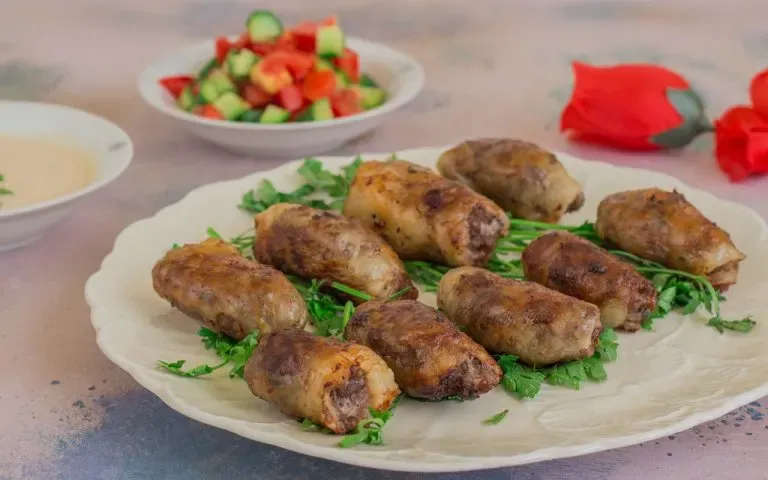
Tarb is kofta wrapped in caul fat and grilled, and the caul is what the dish is named for. Tarb is the Egyptian word for the lacy membrane of fat that surrounds a lamb's stomach, and wrapping seasoned minced lamb in it produces something that ordinary kofta cannot: the fat renders during cooking, bastes the meat from the outside in, and crisps to a golden shell.
Its occasion is Eid al-Adha, the festival of sacrifice, and the connection is direct rather than customary. Eid al-Adha involves the slaughter of an animal and the distribution of its meat, and caul fat is one of the parts that becomes available when a whole lamb is broken down at home. A dish built on caul is a dish that belongs to the moment when a whole animal is being used, which is why tarb appears then and rarely otherwise.
Kofta itself runs across Egypt and the whole Middle East, minced meat with onion, parsley and spices, formed and grilled. Tarb is the version that takes it somewhere richer, and Egyptians treat it as a heavy dish for a family celebration rather than everyday food. It is found in the grilled meat restaurants that specialise in kofta, kebab and grilled chicken across Egypt, served with rice or pasta.
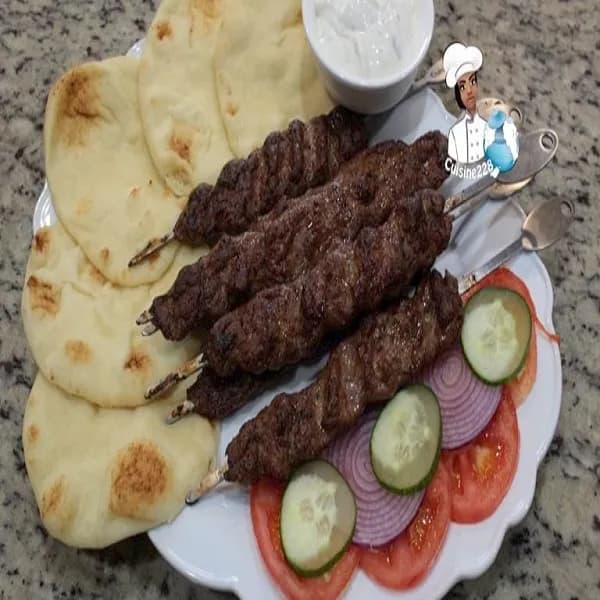
Kofta is minced meat, seasoned and shaped by hand, and it runs across an enormous stretch of the world: from the Balkans through Turkey, the Levant and Egypt, across the Arabian peninsula, into Central Asia and the Indian subcontinent, and along the North African coast. The Egyptian version is lamb or beef with onion, parsley, mint and a warm spice mix, moulded onto skewers and grilled.
Its written history is old. Recipes appear in the earliest surviving Arab cookbooks, where large ground lamb meatballs were glazed in saffron and egg yolk, a technique that later reached Europe and was known there as gilding or endoring. From the Arab world it travelled east, and nargisi kofta was served at the Mughal court in India.
In Egypt, kofta belongs to the grilled meat restaurants that exist in every town, where it is cooked alongside kebab, grilled chicken and tarb and served with rice, bread and salad. The distinction Egyptians draw between kofta and kebab is worth knowing: kebab is cubed meat on a skewer, kofta is minced meat shaped by hand. It is essentially sausage without a casing, and the comparison to a hamburger, sometimes made, misses that it is almost never served in bread.
Pearl barley cooked and cooled, tossed with grilled courgette, aubergine and peppers in a cumin and lemon dressing, with feta, herbs and pistachios. No country is claimed.
**It is finished with pistachios, which the title gives no indication of.**
Barley is the interesting part and the source makes a genuine point about it. In Egypt barley is eaten as a breakfast or dessert porridge rather than in salads, and it is one of the oldest cultivated grains in the region, domesticated in the Fertile Crescent and grown around the Nile for thousands of years. Turning it into a grain salad with grilled vegetables and feta is a modern Mediterranean move rather than an inherited one, which is worth being clear about.
The technique that matters is cooling the barley completely before dressing it. Warm barley absorbs dressing greedily and unevenly, and it wilts the herbs. Cooled, it takes the dressing without soaking it all up in the first two minutes.
Soaking the barley for an hour before cooking shortens the cooking time considerably and helps it cook evenly.
Grilling the vegetables rather than roasting them is deliberate: the char is a flavour in its own right and it is the main thing standing up to the barley's earthiness.
Its health section has not been carried across.