

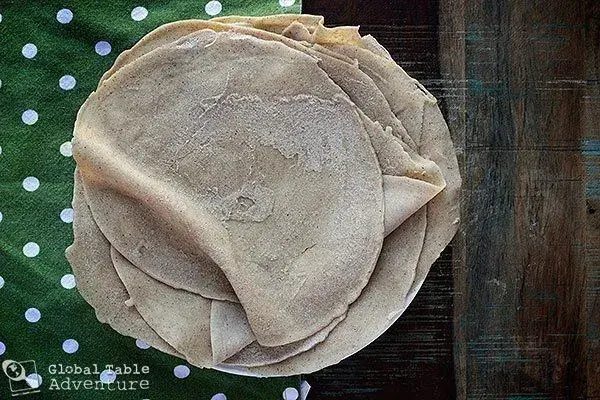
Kisra
Overview
Kisra, also spelled kissra, is the fermented flatbread of Sudan, South Sudan and Chad, made from sorghum flour left to ferment overnight and spread paper thin on a hot griddle. It is a staple rather than an accompaniment, and in Sudan its production has become a home based industry supplying households that no longer make it themselves. It comes in two forms. Kisra rhaheefa is the thin baked sheet, closely comparable to Ethiopian injera in appearance and in the lactic fermentation that produces it, though made from sorghum rather than teff. Kisra aseeda, also called aceda, is the same base cooked into a thick porridge instead. The two are eaten in different contexts and both are called kisra. The fermentation is what determines quality, and Sudanese cooks judge it by several variables at once: the sorghum genotype, the age and strength of the starter, the temperature and the time. Lactic acid bacteria and yeast do the work, producing the acids and alcohols that give kisra its sour flavour and its aroma. A weak or young starter gives a bland bread, which is why starters are kept going and shared between households.
AFN Heritage Note
Kisra is a staple fermented sorghum flatbread of Sudan, South Sudan and Chad, produced through lactic acid and yeast fermentation. It exists in two documented forms: kisra rhaheefa, the thin baked sheet, and kisra aseeda, a thick porridge.
Ingredients
Dietary tags are provided by contributors as a guide, not verified by AFN, and they depend on the products you buy. If you have a serious allergy, check every ingredient yourself. Cooking, allergies and your own judgement
Directions
- 1
Mix the sorghum flour with 1 1/2 cups of water and leave to sit overnight, at least 12 hours, so it ferments.
- 2
The next day, stir in the all purpose flour and the last cup of water to form a thin batter.
- 3
Grease a wide pan lightly with sesame oil and set it over medium heat.
- 4
Ladle some batter into the pan and immediately spread it thin and smooth with a scraper held at about a 30 degree angle. This takes practice.
- 5
When the edges begin to curl up, the kisra is done. It should take only about a minute.
- 6
Stack the sheets on a plate and keep them warm under a cloth.
- 7
Let them cool before serving. They become considerably more flexible and less likely to crack once cooled.
Africook’s Notes
 Personal notes from Nympha Nzeribe
- Give the sorghum a full twelve hours at least. Under fermented batter gives a bland bread with none of the characteristic sourness.
- Keep a little of each batch of batter back as a starter for the next one. A mature starter is what experienced cooks rely on and it strengthens with age.
- Spread the batter fast and thin. It sets almost on contact and hesitating gives you an uneven sheet.
- A scraper held at a low angle works better than a ladle for spreading. In Sudan a flat wooden tool is used for exactly this.
- Let the sheets cool before handling them properly. Warm kisra tears; cooled kisra folds.
- Expect the first few to fail. This is a technique that takes practice and every Sudanese cook says so.
Reviews
3 reviews
Left the sorghum flour with the 1.5 cups water on the counter for the full 12 hours overnight. That fermentation gives it such a lekker mild sourness! Holding the plastic scraper at 30 degrees took a bit of practice on the first two, but once you get the motion right it spreads so thin. Used unroasted sesame oil from Spar and it peeled right off the pan as soon as the edges started curling up.
The overnight fermentation is key sha, that sour taste from the sorghum flour is no be small thing. But abeg I needed to add almost half a cup more water the next day because 1 cup made the batter too thick to scrape properly. Once I thinned it out, it cooked in less than a minute o. E sweet die!
yoh that scraper technique is tricky my broer! First one turned out way too thick like a flop pancake but by the third try I sommer got the hang of spreading it super fast. The smell of that sesame oil when the edges start curling is so nice. Tastes great dipped in beef soup.